
The Open Network for Digital Commerce (ONDC) is providing India with a new source of potential growth. The ONDC initiative will change how digital commerce is done in India by enabling ONDC for small businesses.
Allowing small retailers, local producers, and independent D2C companies to sell directly to customers across India without relying only on large and established eCommerce platforms.
For many years, selling products online has been a privilege reserved for major brands with deep pockets, but ONDC for small businesses is helping create a more inclusive digital marketplace.
Small retailers have been burdened by large commission fees, little visibility and heavy reliance on a third party eCommerce platform.
ONDC changes this reality. It opens digital commerce to everyone and creates a fair, open system where sellers compete based on products, pricing, and service, not platform control.
This blog explains what ONDC is, why India created it, how it works, and how small sellers can realistically grow using ONDC. The language stays simple. The ideas stay practical. The focus stays on real business value.
What Is ONDC and Why It Matters
To create a level playing field for all businesses selling online, the Government of India has introduced Open Network for Digital Commerce (ONDC).




ONDC promotes competition by preventing monopolistic control in e-commerce by connecting different players in the e-commerce ecosystem, including buyers, sellers, logistics providers, and payment processors, through a shared/open network rather than having one platform/company control all of them.
Rather than being an application, ONDC should be viewed as a shared infrastructure that connects multiple apps. Just like UPI connects multiple banks, ONDC connects multiple commerce players. No single company controls the entire system. Every participant follows common standards and operates independently.India created ONDC to ensure that digital commerce grows fairly, transparently, and inclusively.
The Problem With Traditional E-Commerce Platforms
Traditional marketplaces work as closed systems. Sellers join one platform, follow its rules, pay its commissions, and depend on its algorithms for visibility. Over time, this creates several challenges.
Small sellers face:
- High commission fees
- Sudden policy changes
- Account suspensions without clear reasons
- Competition from platform-owned brands
- Limited Control Over Pricing and Customer Relationships
Despite an increase in sales, profits may decrease dramatically. The growth created will feel unstable and uncertain. ONDC was designed to solve exactly these problems.
How ONDC for Small Businesses Works in Simple Language
ONDC does not operate like Amazon or Flipkart. It does not act as a single marketplace.Instead, ONDC works as a network that connects different applications and services.
One Product Listing, Multiple Buyer Apps
When a seller lists products on ONDC:
- The product becomes visible on multiple buyer apps
- Customers can discover the product from different platforms
- Sellers do not need separate setups for each app
This structure increases reach and creates healthy competition.
Why ONDC Is a Big Opportunity for Small Sellers
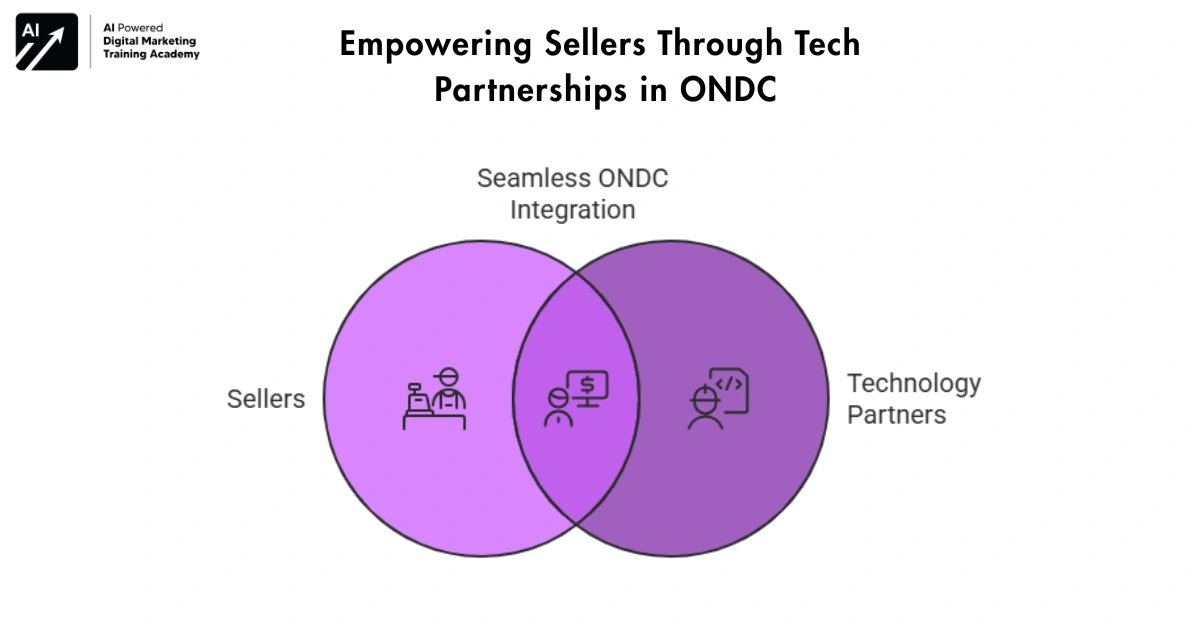
ONDC for small businesses gives small sellers something they never had before: freedom and control.
Key Benefits of ONDC for Small Businesses
- A government-backed and transparent system that offers equal opportunity to Kirana and Large Brands.
- No monopoly ownership
- Equal opportunity for kirana stores and large brands
- Built-in logistics and digital payments
- Open ecosystem with multiple service providers
Platform bias is a thing of the past for sellers! Forget about it and focus on what really counts product quality, price, and customer experience.
Who Can Sell on ONDC
ONDC welcomes almost every type of seller.
Businesses That Can Use ONDC
- Kirana and grocery stores
- Fashion and lifestyle sellers
- Electronics and mobile accessory sellers
- Beauty and personal care brands
- Home and kitchen product sellers
- Local manufacturers and artisans
- Brands that desire to grow D2C
No need for a large workforce or sophisticated technical ability; the necessary skill set is basic compliance and the ability to adapt.
Product Categories That Perform Well on ONDC
Certain categories already show strong traction on the network.
High-Trend Categories
- Daily necessities and groceries
- Regional food products
- Affordable fashion and accessories
- Electronics accessories
- Home utility items
- Natural and locally made products
Sellers who understand demand trends and price competitively see faster growth.
Income Potential on ONDC: A Realistic View
Many sellers want to know how much they can earn on ONDC.
The honest answer depends on:
- Product demand
- Pricing strategy
- Availability and fulfillment speed
- Customer service quality
Some sellers scale to ₹1-3 lakh per month, depending on category and execution.
This income is possible but not guaranteed. ONDC provides reach.Smart strategy creates results.
Step-by-Step Guide to Start Selling on ONDC
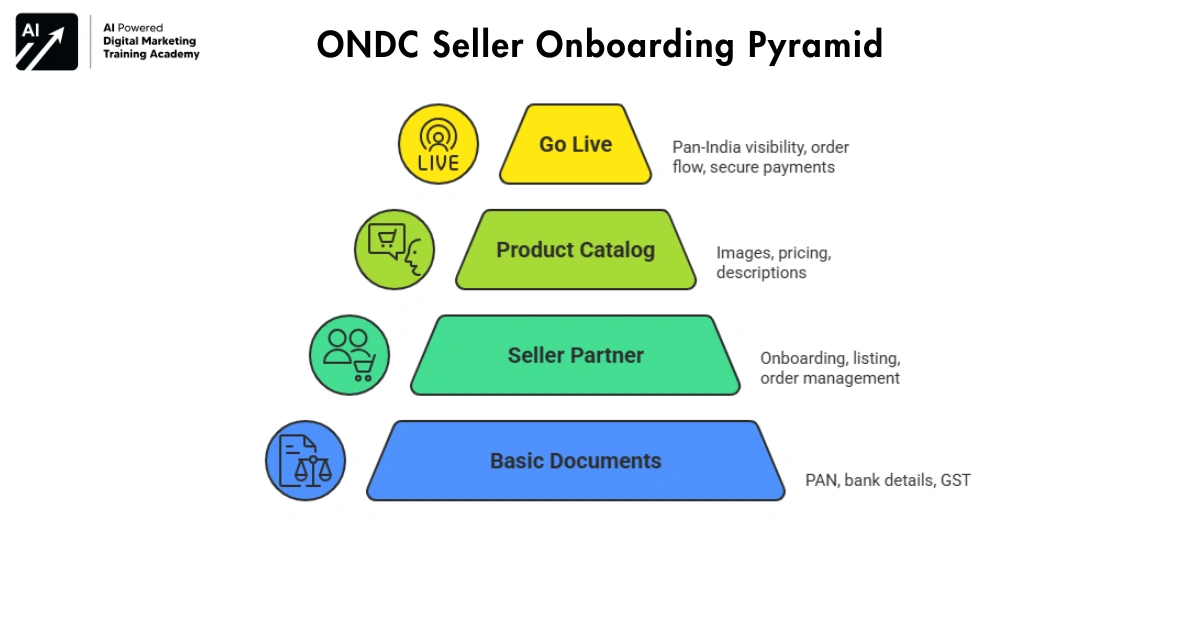
Starting on ONDC does not require complex systems or heavy investment.
Step 1: Prepare Basic Documents
- PAN card
- Bank account details
- GST (if applicable for your product category)
Step 2: Choose an ONDC Seller Partner
Seller partners help you onboard, list products, and manage orders.
Popular partner options include:
- Paytm Seller
- Mystore
- Growth Falcons
Choose a partner that offers good onboarding and support.
Step 3: Create Your Product Catalog
Upload:
- Clear, original product images
- Accurate pricing
- Simple and honest descriptions
Clear listings build customer trust and reduce returns.
Step 4: Go Live and Start Selling
Once approved:
- Your products become visible pan-India
- Orders start coming from multiple buyer apps
- Payments flow through secure digital systems
You manage order fulfillment with built-in logistics support.
Logistics and Payments on ONDC
ONDC simplifies backend operations so sellers can focus on growth.
Logistics Support
- Access to multiple delivery partners
- Competitive shipping options
- Wider geographic reach
Payment Support
- Secure digital payment methods
- Transparent settlements
- Faster payout cycles
This structure removes operational pressure from small businesses.
Why ONDC Is India’s Hidden Goldmine for Small Businesses
ONDC does more than enable online selling. It reshapes how commerce works in India.Small shops gain national reach.Local products reach new markets.Digital power shifts back to sellers.
ONDC supports India’s vision of making every shop digital and national, not dependent and restricted
Real Growth Depends on Smart Usage
ONDC for small businesses is not a shortcut or guarantee scheme. It is an opportunity platform.
Sellers who succeed usually:
- Understand customer needs
- Price products competitively
- Maintain delivery and service quality
- Quickly adjust based on feedback.
Consistency and learning drive long-term growth.
Common Myths About ONDC
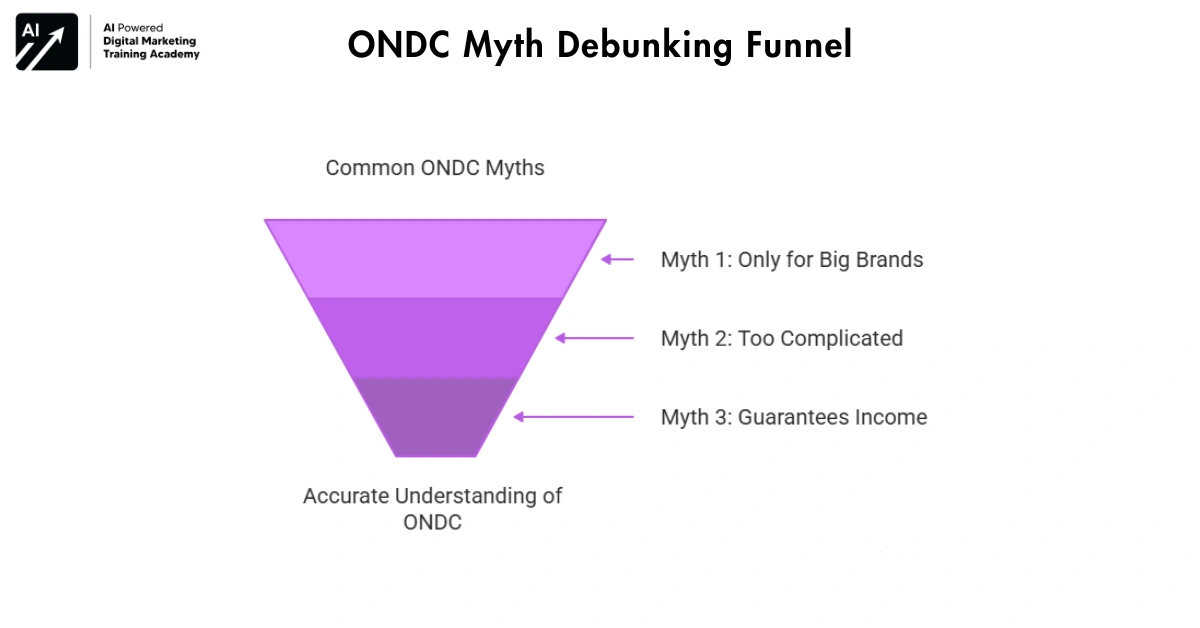
Myth 1: ONDC Is Only for Big Brands
Small sellers actually benefit the most from ONDC
Myth 2: ONDC Is Too Complicated
Seller partners simplify onboarding and operations.
Myth 3: ONDC Guarantees Income
ONDC provides access and reach, not automatic success.
ONDC’s Long-Term Vision for India
ONDC aims to:
- Reduce dependence on closed platforms
- Encourage fair competition
- Empower local and regional sellers
- Strengthen India’s digital economy
The vision of ONDC is consistent with India’s future growth and entrepreneurial objectives.
The Benefits of ONDC Compared to Traditional E-Commerce Platforms
The value of ONDC becomes apparent as you examine traditional E-Commerce Platforms. Listings on ONDC are open to the public so sellers can have competition based on their goods only, not how big of a reach they have to this point.
Sellers now have more freedom to operate as a growing business because they know their competition will be at the product level only.
Traditional platforms control:
- Product visibility
- Search rankings
- Commission structures
- Seller policies
Sellers often adjust their pricing and offers to match platform rules instead of customer needs. ONDC changes this structure completely.
Key Differences Between ONDC and Closed Platforms for Small Businesses
On traditional platforms:
- One company controls buyers and sellers
- Sellers depend heavily on algorithms
- Platform-owned brands often get priority
On ONDC:
- No single company controls the ecosystem
- Sellers reach buyers through multiple apps
- Competition happens at the product level
The move away from the traditional distribution model provides both flexibility and confidence in developing viable sustainable business models for sellers.
ONDC’s Impact on the Development of Kiranas and Local Shops
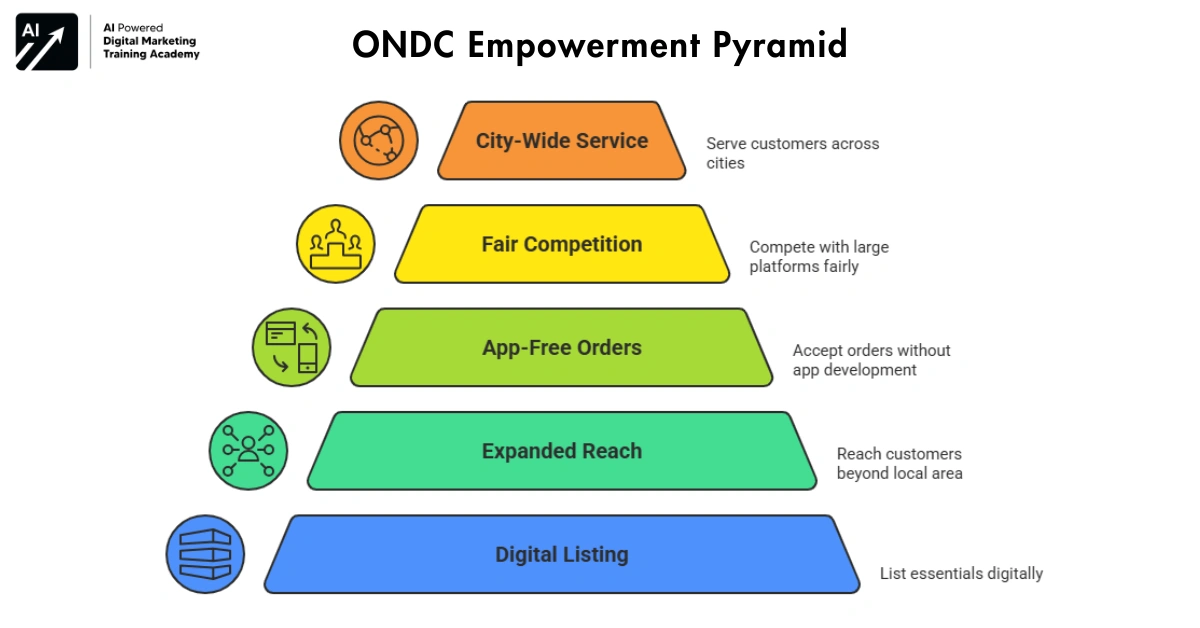
India’s kirana (corner) retail stores represent the foundation of Indian retail; nevertheless, for the last several years, many of these retailers have operated offline because they cannot overcome various technical obstacles and/or their inability to afford the associated costs to operate in an online marketplace. ONDC removes these barriers.
Kirana stores can:
- List daily essentials digitally
- Reach customers beyond walk-in traffic
- Accept online orders without building their own apps
- Compete with large grocery platforms fairly
A kirana store that once served a single neighborhood can now serve customers across cities through ONDC-enabled buyer apps.
ONDC: A Game-Changer for D2C Brands and Startups
Acquiring new customers through traditional e-commerce has proven to be a challenge for many direct-to-consumer brands since many new brands’ advertising costs eat into their profit margins, and also because the visibility and awareness of new brands depend on how much advertising they can do.ONDC offers an alternative growth path.
D2C brands benefit by:
- Reaching customers organically through multiple apps
- Reducing dependency on paid ads
- Testing demand in new regions without high investment
- Maintaining better control over pricing and brand identity
This makes ONDC an attractive option for early-stage and growing D2C businesses
Customer Experience on ONDC
A strong seller ecosystem only works when customers enjoy a smooth experience.
ONDC improves customer experience by:
- Allowing product comparison across sellers
- Offering multiple payment options
- Supporting transparent pricing
- Enabling faster discovery of local and regional products
When customers see fair prices and diverse options, trust increases. That trust directly benefits sellers.
Role of Technology Partners in ONDC
Many sellers worry about technical complexity. ONDC addresses this through technology partners.
Technology partners:
- Provide seller dashboards
- Help manage inventory and orders
- Support catalog uploads
- Offer analytics and reporting tools
Sellers focus on business operations while partners handle technology.
Marketing and Visibility on ONDC
The ONDC ecosystem is built on many different factors to determine product visibility. For example, while price and product availability are certainly two important factors that determine product visibility – providing marketplace service also has an element of determining visibility.
To improve visibility, sellers should:
- Keep accurate stock levels
- Use clear product titles and images
- Offer competitive pricing
- Maintain good delivery performance
Over time, consistent sellers build stronger visibility across buyer apps.
Key Challenges Sellers Must Understand Before Selling on ONDC
Just like all other types of ecosystems, there are many opportunities for growth – from the expanding marketplace, to managing the logistics of order fulfilment and the ability to set customer service expectations within each region serviced by ONDC.
Some common challenges include:
- Understanding network-based selling
- Effectively manage the fulfillment process
- Working together with your logistics partners
- Setting the expectations of customers in different regions
Sellers who invest time in learning the system overcome these challenges quickly.
Best Practices for Growing on ONDC
Successful sellers usually follow a few simple practices.
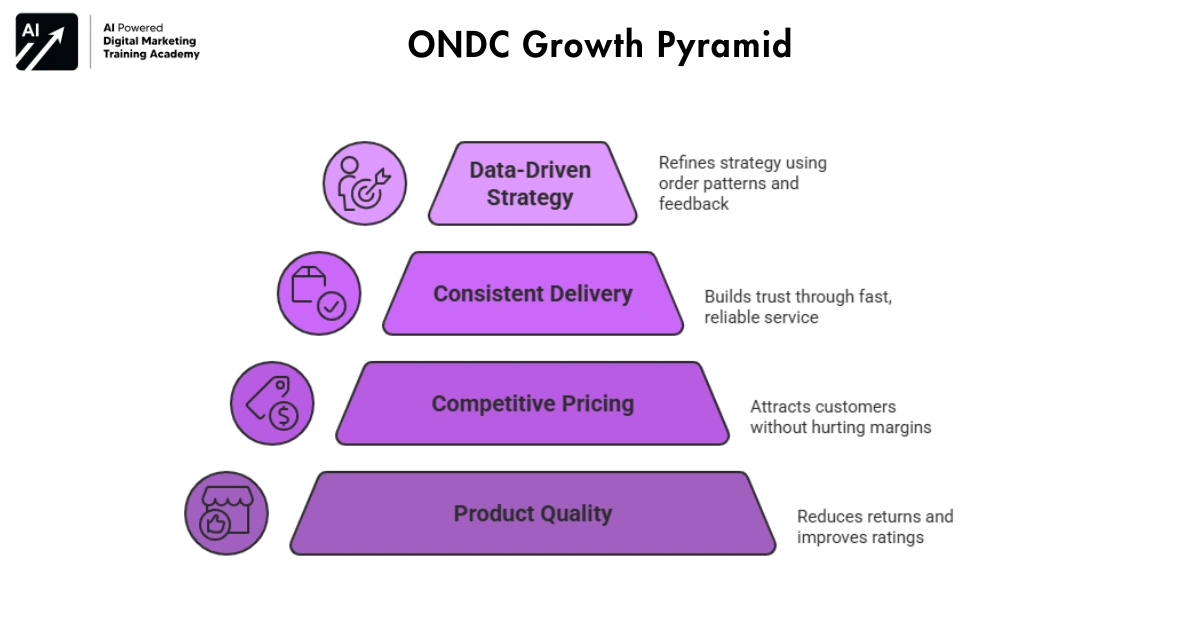
Focus on Product Quality
Good quality reduces returns and improves customer ratings.
Price Smartly
Competitive pricing will not only draw in new customers to your brand, but it also won’t hurt your margins.
Consistency in Delivery
Fast and reliable delivery builds trust.
Learn From Data
Order patterns and customer feedback help refine strategy.Growth on ONDC comes from continuous improvement, not shortcuts.
The Future of E-Commerce in India with ONDC
ONDC represents a shift from platform-based to network-based e-commerce.
In the future:
- More buyer apps will join
- More sellers will come online
- Logistics options will expand
- Competition will become healthier
This evolution will benefit consumers and sellers alike.
Final Perspective on ONDC for Small Businesses
ONDC for small businesses creates opportunity, not dependency.
It allows sellers to:
- Reach national markets
- Retain control over business decisions
- Reduce platform risk
- Build long-term sustainability
For small businesses, ONDC offers something rare in digital commerce: freedom with scale.India’s digital commerce future will not belong to a few large platforms.
It will belong to sellers who adapt early, learn continuously, and serve customers better.ONDC is the foundation of that future.
Why ONDC Deserves Your Attention Now
ONDC is still evolving, and that creates opportunity. Early adopters learn faster, build visibility earlier, and gain customer trust sooner.
You do not need:
- Large investments
- Advanced technology teams
- Heavy advertising budgets
You need awareness, action, and consistency.
“ONDC is not just another platform.It is India’s next digital growth engine.”