

India’s startup ecosystem has matured now. Capital is selective. Investors evaluate fundamentals more than growth claims. Execution quality determines survival in this environment.
Most startups fail because the idea was not weak. They fail because execution was careless. Understanding the common startup mistakes in India is no longer optional. It is necessity.
We will discuss what are the mistakes, why they matter and how early-stage founders, students and small business owners can avoid structural failure.
What are Common Startup Mistakes in India?
Common startup mistakes are predictable execution errors that weaken financial stability, operational clarity or governance.
They typically occur when founders:
- Scale before validating demand
- Raise capital without financial discipline
- Ignore startup unit economics
- Neglect legal structure
These are not rare exceptions. They are repeated patterns across early-stage ventures.
Why Common Startup Mistakes Matter?
The Indian ecosystem has switched from Growth at Any cost to Sustainability First.
Investors now prioritize financial discipline metrics:
Related Posts




- Contribution margin
- CAC vs LTV ratio
- Burn multiple
- Governance standards
Startups that ignore these metrics struggle to raise follow-on capital. Those that maintain financial discipline secure stronger valuations and investor confidence.
Execution strength now directly impacts funding access.
The 8 Most Common Startup Mistakes in India
1. Hiring too Fast before Revenue Stabilizes
Hiring early often happens based on projected growth rather than proven revenue.
Salaries are fixed costs.
Revenue in early startups is variable and uncertain.
When hiring precedes product-market fit, burn rate increases without guaranteed return. This reduces runway and forces premature fundraising.
Disciplined startups hire after validating consistent revenue streams.
2. Raising Funds Too Early and Diluting Equity
One of the most damaging startup funding mistakes is premature dilution.
Raising capital without traction leads to:
- Weak negotiation power
- High investor expectations
- Future down-round risk
Funding should scale validated demand. It should not finance experimentation that could be bootstrapped.
Founders who preserve equity early maintain strategic control later.

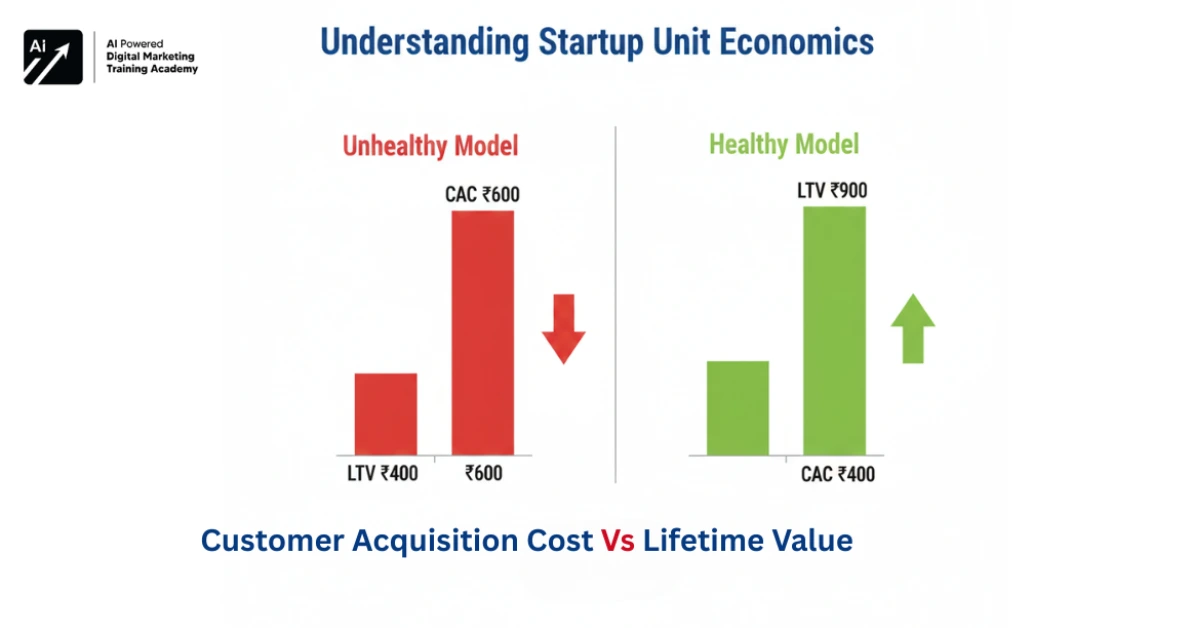
3. Ignoring Startup Unit Economics
Among all common startup mistakes, ignoring unit economics causes the most structural damage in India.
If Customer Acquisition Cost (CAC) exceeds Lifetime Value (LTV), scaling increase losses.
Revenue growth without positive contribution margin is financially fragile. Investors evaluate unit economics before growth projections.
Startups that do not understand these metrics operate without financial visibility.
4. Choosing the Wrong Co-Founder
Founder alignment issues destroy startups quietly.
Common problems include:
- Undefined roles
- Equal equity without equal contribution
- No vesting agreements
Emotional compatibility is not operational alignment.
The equity logic, responsibilities, and exit terms from day one are defined by strong founder agreements.
5. Skipping Customer Validation
Founders must validate demand before choosing among different business models.`
Assumptions are expensive. Market feedback is cheaper.
Introducing Minimum Viable Products (MVPs) and testing them with early users is a significant way for startups to reduce risk. Those that build in isolation often discover weak traction too late.
Validation must precede expansion.
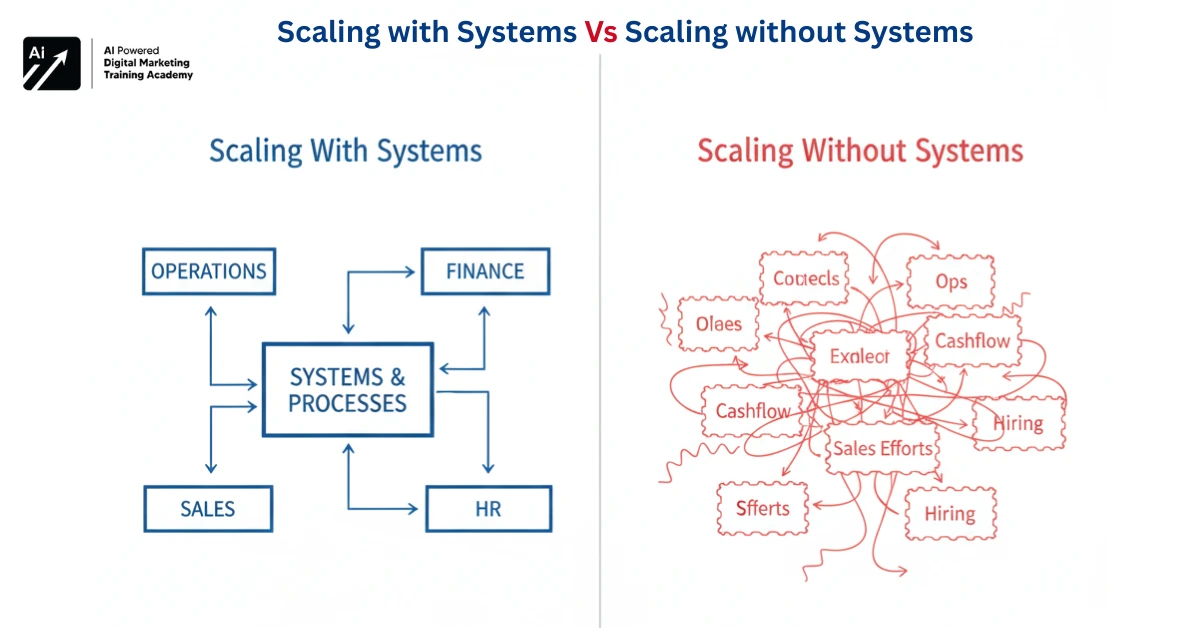
6. Scaling Without Systems
Growth amplifies internal structure. Scaling accelerates breakdown if systems are weak.
Startups must stabilize, before expanding geography, increasing marketing spend or launching new verticals:
- Revenue repeatability
- Team accountability
- Operational processes
Scaling without structure increases operational chaos.
7. Weak Organizational Culture
Culture influences retention and execution speed.
Toxic work environments damage reputation and productivity and leads to High attrition, increases recruitment cost and reduces continuity.
Early cultural discipline creates long-term execution strength.
8. Ignoring Legal and Compliance Structure
Many early-stage Indian startups delay compliance to save cost or time.
Common oversights include:
- No trademark registration
- Weak shareholder agreements
- Poor documentation
Legal structure protects equity and investor confidence, when issues surface during fundraising or disputes.
Compliance is foundational, not administrative overhead.
What Are the Biggest Startup Mistakes in India?
The biggest startup mistakes in India are:
- Over hiring before revenue validation
- Raising funds too early
- Ignoring unit economics
- Founder misalignment
- Lack of customer validation
- Scaling without systems
- Weak work culture
- Poor legal compliance
These mistakes increase burn rate, reduce runway and decrease in long-term survival probability.
Benefits of avoiding these Mistakes
To increase capital efficiency and increase runway, it is important to avoid execution errors. It protects equity of the founder and improves investor confidence.
Operational discipline develops scalable leadership capability that improve decision-making quality, essential for long-term growth.
Prevention compounds. Correction drains resources.
Challenges of Founders
The reason for the difficulty in avoiding mistakes is:
- Competitive pressure drives rapid scaling.
- Aggressive risk-taking is a result of limited capital.
- Financial literacy is not possessed by first-time founders.
However, disciplined founders make decisions that are slower but more effective. Always sustainability is their top priority over optics.
Practical Framework to avoid Common Startup Mistakes in India
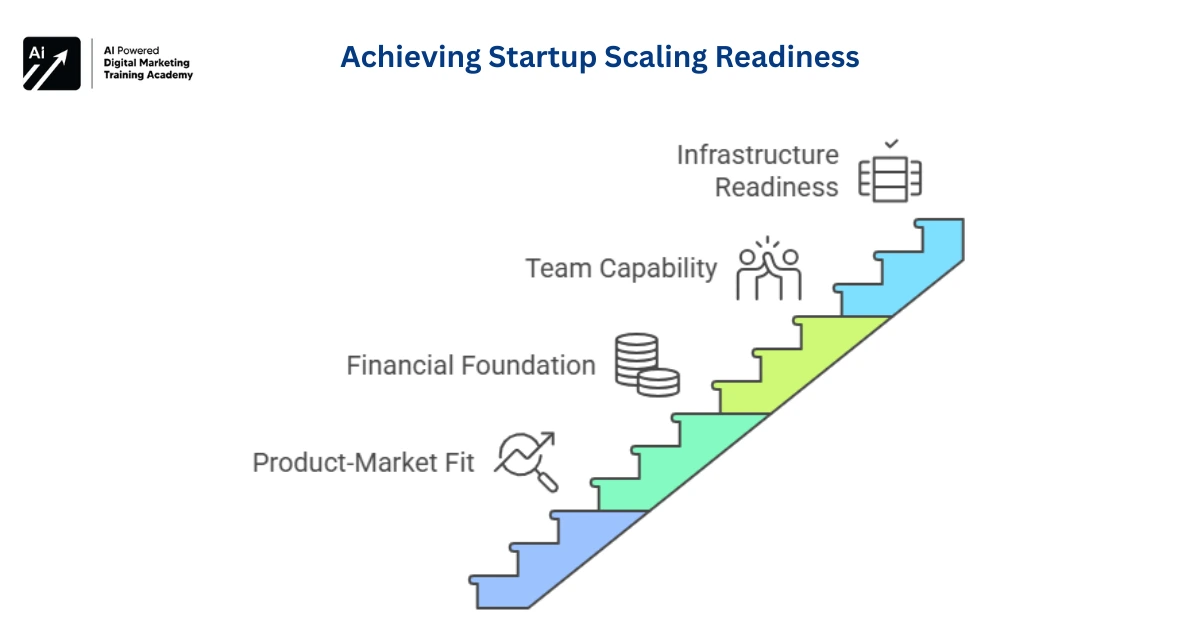
- At First, build financial literacy, understand CAC, LTV, burn rate and contribution margin before expanding.
- Second, validate demand before large hiring or fundraising.
- Third, formalise founder agreements and compliance early.
- Fourth, audit internal systems before scaling operations.
Execution audits should occur at every growth milestone.
FAQ: Common Startup Mistakes in India
What causes startups to fail in India?
The primary cause is the ineffective execution, specifically neglecting unit economics and scaling before product-market fit.
When should a startup raise funding?
Demand has been validated, revenue stabilised, and healthy unit economics have been demonstrated.
Why are unit economics critical for Indian startups?
They determine whether scaling creates sustainable profit or increases losses.
How can early-stage founders reduce failure risk?
Validating customers early, maintaining financial discipline, properly structuring governance, and scaling gradually are all strategies that can be used.
Conclusion
India offers strong startup opportunity. Capital exists. Markets are expanding.
But growth without discipline is unstable.
Understanding common startup mistakes in India allows founders to prevent predictable failures. Strong execution builds durable companies. Weak execution collapses under pressure.
Before scaling, evaluate fundamentals. Sustainable growth is built on structure, not speed.