
At the start of the year, I thought I was good at AI. I knew how to write prompts, understood tools, and mainly followed trends. Then I started building seriously, and that is when everything changed. Using AI normally and building with AI professionally are two different worlds. That is when I truly understood what AI skills for career growth in 2026 really mean not just using tools, but creating real results with them.
In 2026, AI will not replace everyone, but someone who understands the right AI skills for career growth in 2026 might replace you. That is the reality where AI is no longer optional and It is becoming infrastructure just like the internet once was. The difference between average professionals and high-leverage professionals is getting wider and the gap is created by skill depth and Let us break this down step by step.
Why AI Skills Matter More Than Ever in 2026
Every technological shift creates two groups:
- People who adapt
- People who wait for too long
In the year 2026, AI is not just a tool.
It is becoming a layer across every industry:
- Marketing
- Finance
- Healthcare
- Law
- Education
- Software
If you ignore AI, your productivity slows down and If you understand AI deeply, your output multiplies. That is the real shift and AI skills are not about coding only.




They are about:
- Thinking clearly
- Automating smartly
- Managing systems
- Reducing manual work
- Increasing strategic focus
Professionals who learn this early gain an unfair advantage. And that advantage compounds.
Build Leverage Instead of Working Harder
Most people try to grow their career by working longer hours. But AI changes the formula.
Just doing work for 12 hours, you can:
- Automate 4 hours
- Delegate 3 hours to AI
- Focus 5 hours on high-value decisions
- That is leverage.
- And leverage scales.
The goal is not to become dependent on AI, the goal is to become powerful with AI.
The Mindset Shift Professionals Need
AI is not competition and it is amplification.
- If you have clarity → AI increases clarity.
- If you have confusion → AI increases confusion.
That is why learning structured AI skills matters. Now let us understand and go to the actual skill stack.
10 AI Skills for Career Growth in 2026
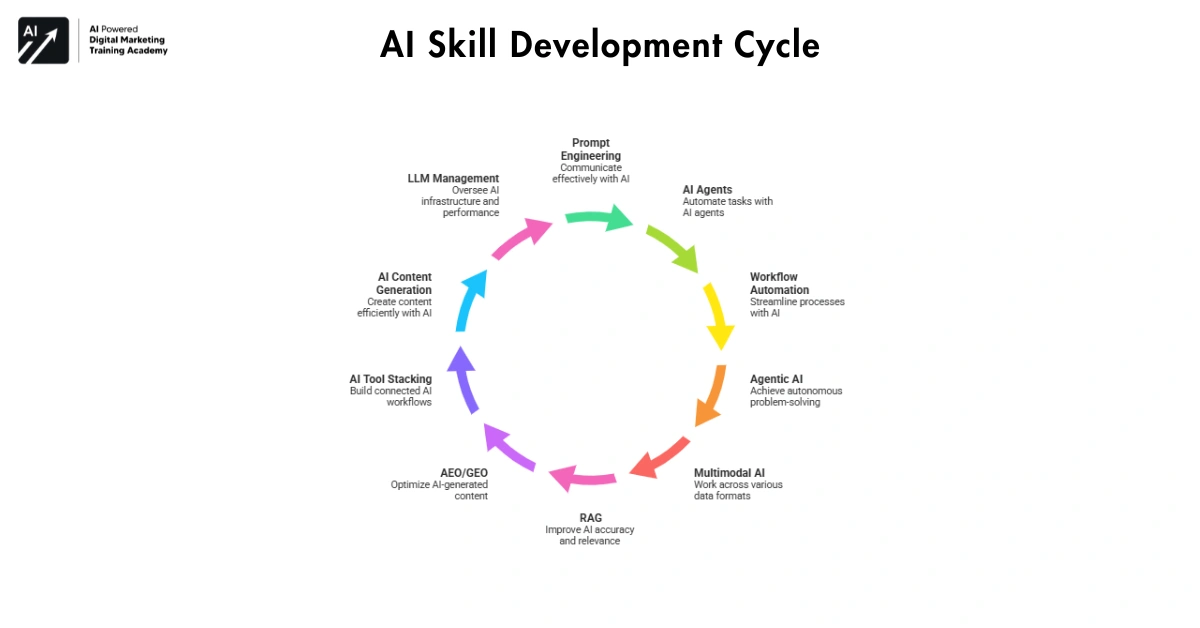
Prompt Engineering
Before you automate anything, you must learn how to communicate with AI. Prompt engineering is the foundation. Clear prompts turn AI from a text generator into a thinking partner. When using platforms like OpenAI.
Results depend heavily on:
- Context
- Structure
- Constraints
Examples
- A weak prompt gives generic answers.
- A structured prompt gives strategic output.
- Prompt engineering is structured thinking.
AI Agents
Replies are easy and completion is valuable. AI agents take a goal and execute it step by step. Frameworks like LangChain and projects such as AutoGPT are moving in this direction.
AI agents can:
- Break goals into sub-tasks
- Call tools
- Evaluate results
- Retry when errors happen
This is where AI becomes a digital operator.
Workflow Automation
If something repeats then just automate it and tools like Zapier and n8n make this automation simple. When we combine AI, automation becomes more intelligent and easy. Automation frees your mental space and mental space is where strategic thinking happens.
Agentic AI
Agentic AI goes beyond basic automation. Companies building advanced systems on models from Anthropic and Google DeepMind are exploring this deeply.
Agentic systems can:
- Re-plan when blocked
- Optimize decisions
- Adjust based on feedback
This is closer to autonomous problem solving.
Multimodal AI
AI is no longer needed, not only text . Companies like Google and OpenAI are pushing multimodal capabilities.
You can now work across:
- Text
- Images
- Audio
- Video
- Code
Thinking about many formats like images, file and text makes you more creative.
RAG (Retrieval-Augmented Generation)
Generic AI can make mistakes and RAG reduces that risk. Vector database companies like Pinecone and Weaviate support this structure.
RAG improves:
- Accuracy
- Relevance
- Consistency
This is how AI starts functioning like a trained employee.
AEO / GEO
Search is changing and seo helps websites to rank higher on search engines. Now visibility inside AI-generated answers matters. AEO defined as Answer Engine Optimization and GEO is defined as Generative Engine Optimization focus on:
- Clear structured answers
- Authoritative content
- Strong topical coverage
AI Tool Stacking
One tool is helpful and connected tools become a system. Instead of switching between tools randomly, just build a connected workflow. Knowing 4 or 5 tools very well is better than knowing 20 tools a little bit.
AI Content Generation
Content production is easier than ever.
AI helps with:
- Drafting
- Outlining
- Repurposing
- Editing
The smart approach is:
- AI handles speed.
- You handle insight.
- Consistency builds authority.
LLM Management
This is the hidden skill and Infrastructure from companies like Microsoft and Amazon supports deployment.
But management requires:
- Monitoring token usage
- Choosing the right model
- Tracking ROI
- Controlling latency
With management, AI becomes scalable.
Common Mistakes Professionals Make with AI
Most career setbacks will not happen because AI is difficult and they happen because people misuse it.
Common mistakes:
- Using AI without strategy
- Copy-pasting outputs blindly
- Ignoring data privacy
- Not validating responses
- Relying on one tool only
- AI should assist thinking.
How Long Does It Take to Build These AI Skills?
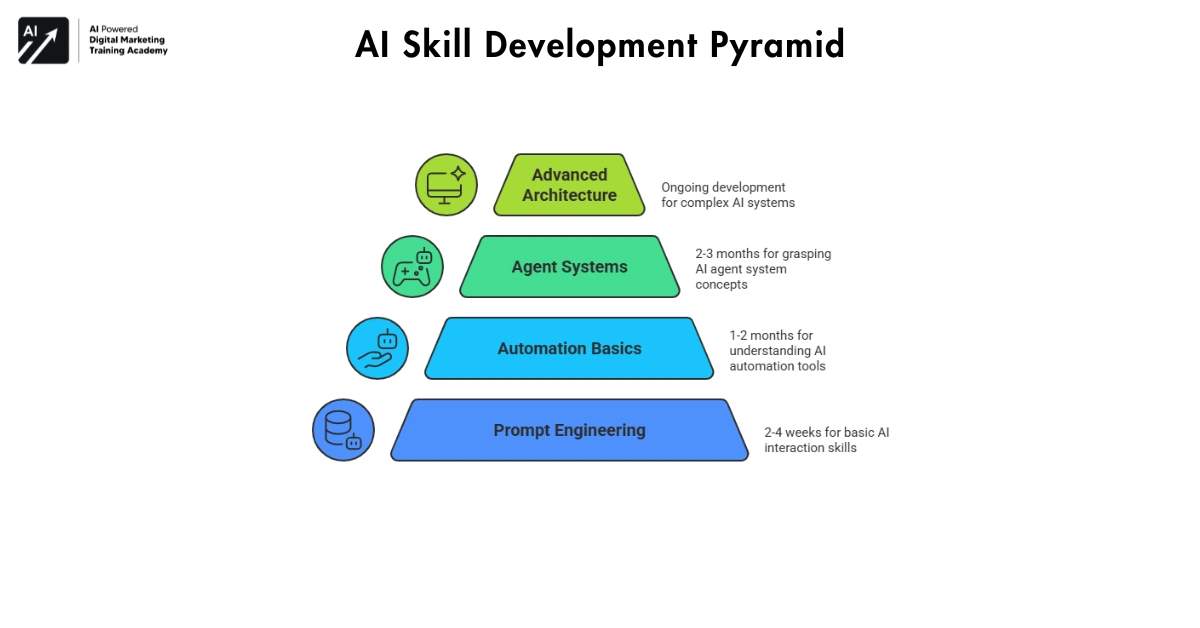
You do not need 5 years and need structured focus.
A realistic timeline:
- Prompt engineering → 2 to 4 weeks
- Automation basics → 1 to 2 months
- Agent systems understanding → 2 to 3 months
- Advanced architecture → ongoing
Here consistency matters more than speed.
The Future of AI Careers in India
India is entering a strong AI growth phase and cities like Hyderabad, and Pune are already using AI tools very fast.
AI is spreading across:
- Digital marketing agencies
- E-commerce brands
- Fintech startups
- EdTech platforms
- Healthcare services
- Freelancing businesses
The demand is shifting from “AI developers” to “AI-enabled professionals” and that is a big difference.
Career Roles That Will Grow with AI
Over the next few years,
hybrid roles will grow:
- AI Workflow Consultant
- Automation Architect
- Prompt Strategist
- AI Product Manager
- RAG Implementation Specialist
Companies will need people who:
- Understand business problems
- Translate them into AI workflows
- Manage tools efficiently
- Measure ROI clearly
Strategic thinking matters more than technical depth alone.
The Real Competitive Edge
The biggest mistake is thinking AI is a tech skill only and it is a leverage skill. If you combine domain knowledge along with AI capability you become rare and rare skills earn more income.
How to Build AI Skills Without Feeling Overwhelmed
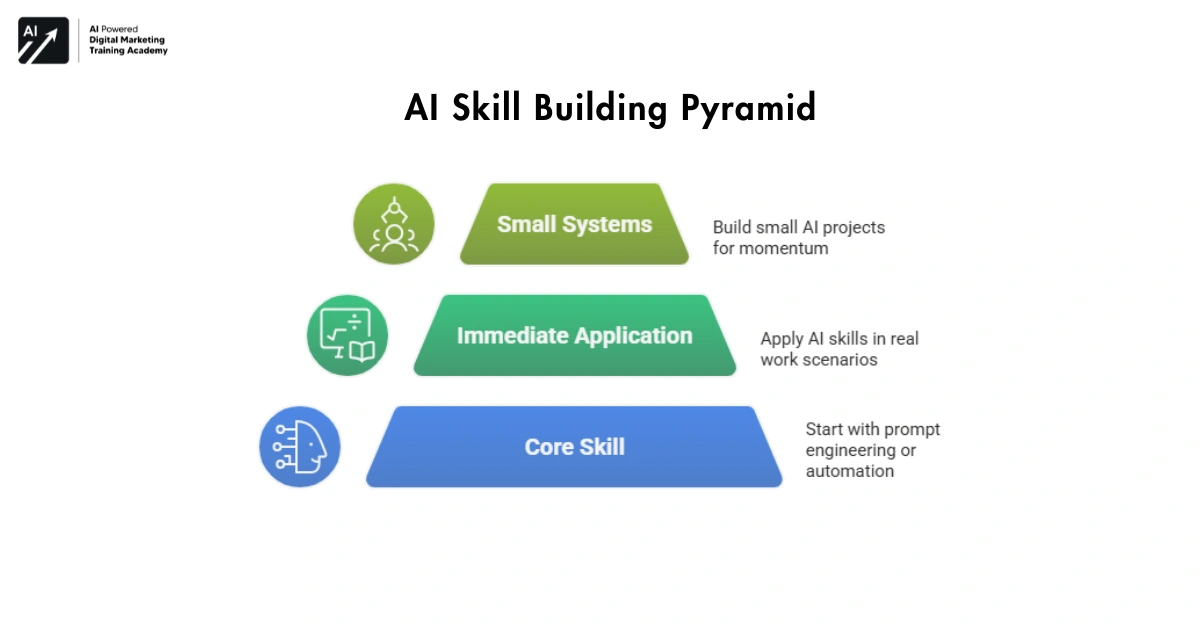
- Many professionals feel excited about AI.
- But they also feel confused.
- There are too many tools.
- Too many tutorials and opinions.
- This mistake will help you to learn everything at once.
- That can make you very tired and stressed.
Instead, follow a simple system:
Step 1: Pick One Core Skill
- Start with prompt engineering or automation.
- Do not jump between 10 tools.
- Depth creates confidence.
Step 2: Apply Immediately
Learning without application fades fast.
- You work in marketing → automate campaign reports.
- If you work in HR → build resume screening prompts.
- If you are a freelancer → automate client onboarding.
AI becomes clear only when used in real work.
Step 3: Build Small Systems
Do not aim for big AI projects in the beginning.
Build small systems:
- Auto email reply draft
- Weekly report generator
- Content outline assistant
- Small wins build momentum.
- Momentum builds mastery.
How to Stay Relevant as AI Evolves
- AI tools will change.
- Models will improve.
- New startups will launch.
If you try to follow every new update, you will feel tired and Instead, focus on the basics.
Focus on Principles, Not Just Tools
- Tools change.
- Principles stay.
Understand:
- How AI processes information
- Where AI fails
- How to validate outputs
- How to measure ROI
If you understand systems thinking, switching tools becomes easy.
Build a Learning Routine
Spend:
- 30 minutes daily experimenting
- 1 day per month reviewing workflows
- 1 project per quarter improving automation
- Consistency beats intensity.
Professionals who build learning habits stay ahead without stress.
What High-Performing AI Professionals Do Differently
- The difference is not intelligence.
- It is behavior.
Average professionals complete tasks and High-performers design systems. Instead of writing one report, they build a report generator. Instead of replying manually, they build response frameworks and systems create leverage.
They Track Impact
They measure:
- Time saved
- Cost reduced
- Revenue increased
- Errors minimized
AI is not for experimentation only and It must produce measurable value.
They Combine Human Judgment with AI Speed
- AI gives speed.
- Humans give direction.
- AI gives options.
- Humans make decisions.
- This combination creates power.
- Not dependency.
These additional sections strengthen your article by adding:
- Practical action steps
- Long-term relevance strategy
- Behavioral insights for professionals
If you want, I can now optimize the full article structure for SEO with clean H1 to H3 hierarchy and keyword placement balance.
Conclusion: AI Is Not Replacing You, But Skill Gaps Will
At first, I thought I understood AI and later, I understood I only knew a small part of it. The difference between casual users and builders is widening. You do not need all 10 skills immediately. But you must start, because AI skills for career growth in 2026 are not optional upgrades and they are foundational capabilities. Start with one skill and master it and then stack the next.That is how careers compound. And 2026 will reward those who prepared early.