
But what if someone considered you and all the other diligent people who pay their credit cards on time, too?
That might sound strange to hear a few years ago.
However, this very simple proposition ended up as one of the hottest fintech success stories in India
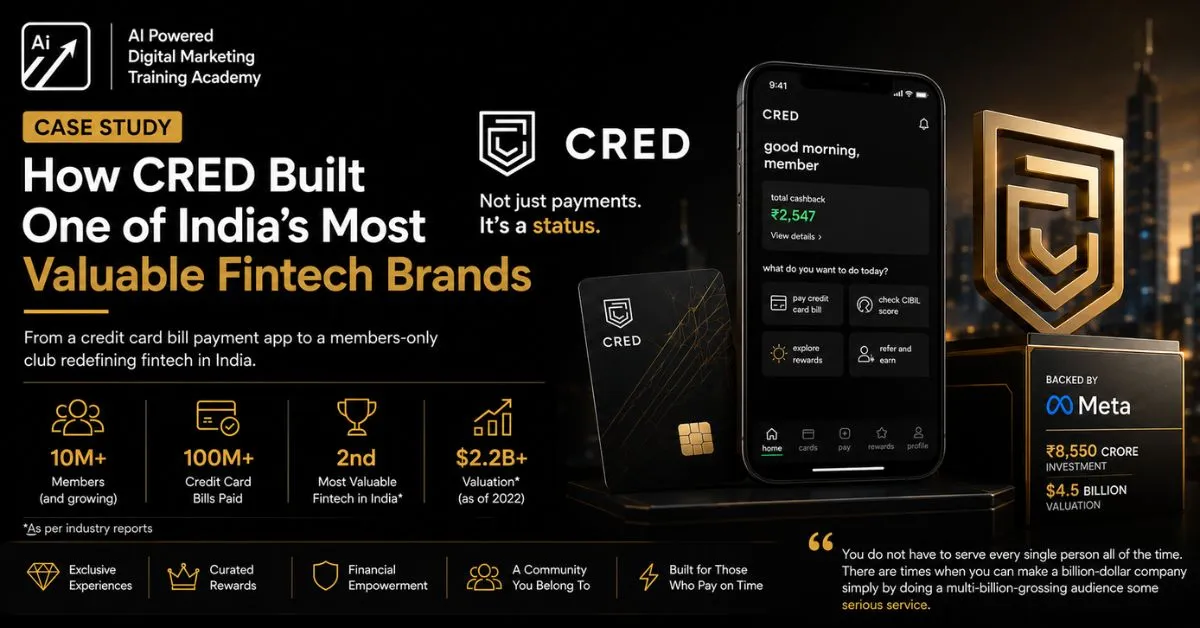
Today, CRED is used by millions of Indians to make credit card bill payments, UPI payments and select financial products as well as gain access to exclusive rewards and experiences.
This company is one of India’s top fintech brands and gained international visibility when Meta invested about ₹8,550 crore ($900 million) in the company
CRED was valued at $4.5 billion (₹43,200 crore) after its latest round of funding
This is the CRED Case Study. This is not another fintech startup story.



It is a masterclass in:
- Problem-solving
- Brand positioning
- Community building
- Customer experience
- Product innovation
- Digital marketing
- Long-term thinking
- Premium brand creation
The biggest lesson for entrepreneurs and digital marketers is easy
You do not have to serve every single person all of the time.
There are times when you can make a billion-dollar company simply by doing a multi-billion-grossing audience some serious service
Understanding India’s Financial Landscape Before CRED
Before understanding the CRED Case Study, we will need to understand the financial environment of India
India is among the fastest digital economies of the world Digital payments have exploded.
UPI transactions have transformed commerce. The use of the credit card has shown a steady increase as well.
Today, millions of people use online shopping services, digital service subscriptions, and financial applications every day.
But before CRED, there was an obvious missing link Consumers who kept up with the right practices rarely got compensated
Millions of people:
- Paid their bills on time
- Maintained good credit scores
- Managed finances responsibly
- Used credit cards regularly
But there was no purpose-built platform for them.
Kunal Shah saw an opportunity.
He thought financial prudence deserved to be rewarded. That belief became CRED.
Who Is Kunal Shah? CRED Case Study
It all starts with a great co-founding team and co-founders who are able to identify opportunities that most others won’t see
Kunal Shah is one of the most well respected entrepreneurs and investors in India.
He was the founder of FreeCharge, a pioneer in digital payments from India, before CRED.
When FreeCharge exits, most people assume he will either retire or start investing full-time
Instead, he spent time studying:
- Consumer psychology
- Financial behavior
- Technology adoption
- Digital ecosystems
- Trust-driven businesses
He noticed something interesting.
High FICO score Consumers were often:
- Financially responsible
- Digitally active
- High-spending
- Early adopters of technology
- Influential among their peers
These users composed a very desirable segment of shoppers.
But no one was building specific products for them. This observation eventually inspired the genesis of CRED.
The Problem That Inspired CRED
All great startups solve a problem In this instance the issue was behavioral, not technological.
In the meantime, millions of Indians did build their credit card bills responsibly
However, they rarely received:
- Recognition
- Exclusive experiences
- Meaningful rewards
- Premium financial services
- Community benefits
Kunal Shah felt these consumers deserved more.
His idea was simple:
Reward responsible financial behavior.
So simple, yet it turned into one of the largest success stories in fintech that India has had.
The Birth of CRED
CRED launched in 2018.
The platform allowed users to:
- Pay credit card bills
- Earn rewards
- Access premium experiences
- Discover exclusive offers
- Join an exclusive financial community
However, there was a single significant difference. Not everyone could join. Membership was based on creditworthiness.
This immediately created curiosity. People wanted access. The platform felt exclusive.
Instead of becoming another credit card payment app, CRED pitched itself as an exclusive members’ club.
It became one of its greatest strengths in positioning.
Why the CRED Business Model Worked
Positioning is one of the key takeaways of CRED Case Study.
Everyone tries to serve everyone. CRED did the opposite.
The latter was intentionally targeted towards financially prudent consumers. This decision created several advantages
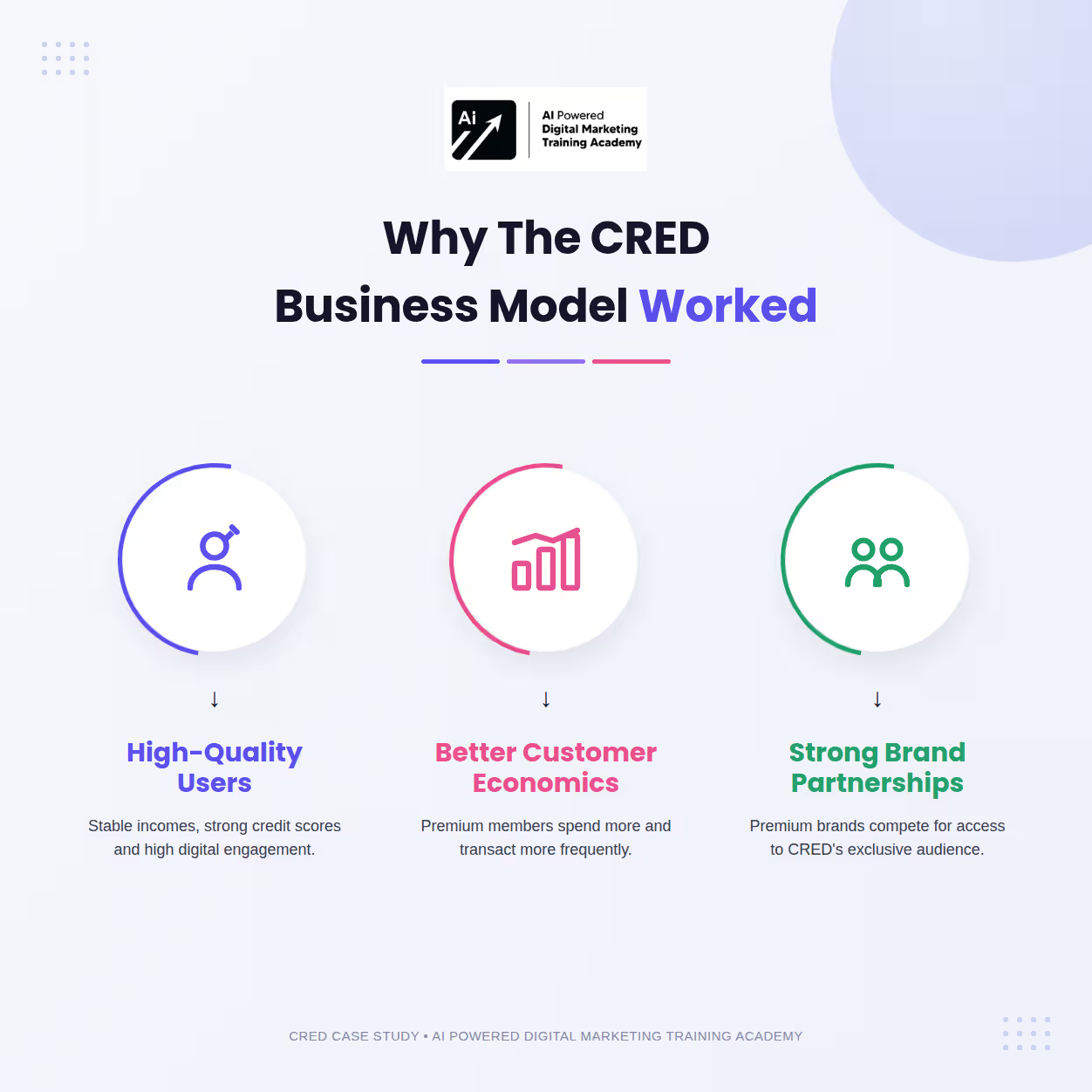
High-Quality Users
Most members:
- Had stable incomes
- Maintained good credit scores
- Used digital products frequently
- Spent more online
- Had higher purchasing power
Brands found these users highly appealing
Better Customer Economics
Premium consumers:
- Spend more
- Purchase frequently
- Value convenience
- Appreciate experiences
This created strong monetization opportunities
Strong Brand Partnerships
CRED has a user base that premium brands want to tap. And in doing so, it opened doors to partnerships and exclusives
How CRED Expanded Beyond Bill Payments
In the fullness of time, CRED evolved into a wider financial ecosystem.
Today, CRED offers multiple services
Credit Card Bill Payments
The core product is still simple and easy to use.
CRED UPI
The application allows users to directly process digital payments.
CRED Cash
This platform offers short credit solutions
CRED Store
Members get access to more premium products and tailored offers
Financial Insights
Spending insights and financial data get sent to the users
Lending and Financial Products
The platform collaborates with banks for extra services.
And this gradual expansion led to higher engagement and more diverse revenue streams.
How CRED Makes Money
Many people ask:
If CRED rewards users, how does the company make money?
The answer lies in diversification
Brand Partnerships
Premium brands pay to reach CRED’s high-quality customer base.
Financial Services
Revenue comes through:
- Lending partnerships
- Financial products
- Credit offerings
- Payment services
Merchant Collaborations
Businesses buy visibility and customer acquisition opportunities
Payment Infrastructure
CRED UPI and such products contribute to incremental revenues.
This helps to decrease reliance on one type of business
Meta’s ₹8,550 Crore Investment Changed the CRED Story
Many major turns happened in the CRED Case Study, One such significant development came after years and that was 2026.
CRED received investment of around ₹8,550 crore ($900 million) from Meta.
The investment had given the company a valuation of approximately ₹43,200 crore ($4.5 billion).
It became one of the largest investments that Meta made in India’s fintech space.
This investment set off a huge series of debates in India’s startup ecosystem.
Why Did Meta Invest in CRED?

Meta’s investment is a vote of confidence in several trends
India’s Digital Payments Growth
India has emerged as one of the largest markets for online payment in a global perspective.
Now millions of consumers each day transact digitally
Increasing Credit Card Adoption
Credit card penetration continues to be lower than that of developed economies.
This creates significant growth opportunities
Strong Consumer Community
CRED has accumulated one of the largest user communities in India that is willingly taking on financial responsibility
These users possess:
- Strong purchasing power
- Digital-first behavior
- High engagement
- Financial awareness
This customer concern is extremely precious.
Long-Term Fintech Potential
Meta increasingly sees opportunities in:
- Digital payments
- Financial technology
- Business services
- Consumer internet platforms
- Commerce ecosystems
CRED is right at the intersection of all those trends
The Branding Strategy That Made CRED Famous
Branding is one of the most essential strengths, in the of CRED Case Study.
Most fintech companies compete on:
- Features
- Discounts
- Cashback
- Interest rates
But CRED chose a different strategy.
It sold
- Exclusivity
- Trust
- Experiences
- Status
- Premium lifestyle
Users did not just use the App
It was a private club that they felt like they belonged to. This positioning balanced on feelings created a stark difference.
Marketing Campaigns That Made CRED a Household Name
A lot of it is CRED’s advertisements which are very creative in nature.
The company frequently used:
- Humor
- Nostalgia
- Storytelling
- Unexpected celebrity appearances
The campaigns blew up online.
Voluntarily, People watched and discussed them
This created:
- Brand awareness
- Social conversations
- Curiosity
- Organic reach
- Strong recall
While CRED demonstrated that financial products could have creative, not boring marketing
Digital Marketing Lessons From the CRED Case Study
The CRED Case Study contains some important lessons for digital marketers
Positioning Is More Important Than Advertising
CRED was crystal clear with whom it served.
Clear positioning simplified communication
Storytelling Creates Emotional Connections
Stories are more memorable than features.
Storytelling was an integral part of CREDs always memorable campaigns
Communities Build Sustainable Growth
Communities generate:
- Trust
- Recommendations
- Engagement
- Loyalty
Low customer acquisition cost Strong community
Customer Experience Is Marketing
Every interaction shapes perception.
CRED focused heavily on
- Design
- Simplicity
- Rewards
- User experience
The experience itself became marketing.
SEO Lessons From the CRED Case Study
Every day, people search for:
- The Best Credit Card Bill Payment App
- How to improve credit score
- Best fintech apps in India
- Credit card rewards
- UPI payment apps
- Financial planning apps
These searches represent demand.
Marketers can intercept this demand with
- Search Engine Optimization (SEO)
- Content Marketing
- Video Marketing
- Educational Content
- Email Marketing
- Social Media Marketing
The biggest lesson Make sure you are seen when people are looking for solutions
Career Opportunities for Digital Marketers in Fintech
So there are large opportunities in front of companies like CRED.
Fintech companies increasingly need
SEO Specialists
To improve search visibility.
Content Marketers
To educate users
Performance Marketers
To acquire customers efficiently.
Product Marketers
To simplify complex products
Social Media Managers
To build communities.
Growth Marketers
To scale customer acquisition
Marketing Analysts
To make data-driven decisions.
Fintech is emerging as one of the fastest-growing industries for a career in digital marketing.
What Entrepreneurs Can Learn From the CRED Case Study
The biggest lessons include:
- Solve meaningful problems
- Build for a specific audience
- Create trust
- Deliver exceptional experiences
- Think long term
- Build communities
- Focus on branding
- Educate customers
- Continuously innovate
Conclusion About CRED case study
CRED case study is among the most interesting stories of startups in India.
He saw a tribe of such financially responsible consumers, chose to build an entire ecosystem of trust, exclusivity, rewards and premium experiences around them
Today, CRED has:
- Millions of users
- Multiple financial products
- Strong brand recognition
- Fintech One of the most valuable banking ecosystem in India
- Meta’s ₹8,550 crore in Global investor confidence
The most important lesson from CRED Case Study is quite simple
Just because you serve a lot of people does not mean that you build a great business.
Usually, however, they are built by knowing an audience extremely well and delivering significant value to them.
Digital marketers can learn just as well from it.
Strong positioning, storytelling, community building, trust, and exceptional customer experiences can transform a simple idea into one of India’s most valuable fintech brands