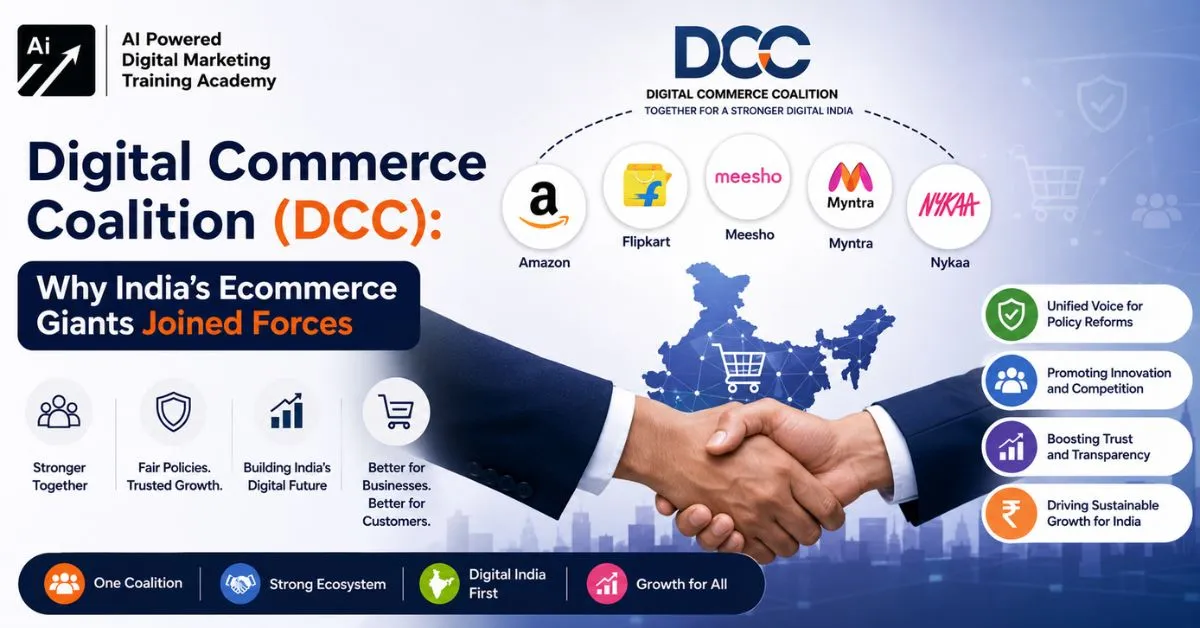

India’s ecommerce sector has turned a page Five of India’s heavyweight digital commerce companies Amazon, Swiggy, Meesho, Zepto and Eternal combined to form the Digital Commerce Coalition (DCC)
Of course, this announcement took many people by surprise since these companies are straight competitors.
The competition plays out on a daily basis for customers, sellers, speed of delivery and market share and growth
So why did they suddenly join hands?
The answer is simple.
India’s digital commerce industry is growing rapidly and becoming increasingly important to the country’s economy.
Ecommerce today is much bigger than online shopping. It affects millions of consumers, small businesses, delivery partners, startups, brands, and digital marketers




As the industry expands, matters relating to consumer trust, responsible innovation, digital regulations and stakeholder coordination are rising higher in concern than before.
The companies behind the (DCC) are of the mindset that some obstacles simply cannot be tackled alone.
They call for collective conversations and collaboration across the industry
The coalition formation signals that India’s digital commerce ecosystem is turning organized, mature, and future smart
What Is the Digital Commerce Coalition (DCC)?
The Digital Commerce Coalition (DCC) is a non-right group comprising industry stakeholders and advocates for domestic producers engaged in digital commerce
The coalition focuses on:
- Policy engagement
- Industry research
- Stakeholder coordination
- Consumer trust initiatives
- Responsible innovation
- Supporting long-term ecommerce growth
Also known as the (DCC), it launched on June 1, 2026
The founding members are:
- Amazon
- Swiggy
- Meesho
- Zepto
- Eternal
Koan Advisory Group, a New Delhi based public policy firm manages secretariat of the coalition.
Collectively this companies touch hundreds of millions of consumers and sellers throughout India.
Significantly, the advent of the Digital Commerce Coalition (DCC) is also an important development as that signals how the digital commerce industry in India has grown up enough to need a structured industry platform.
Why Did Ecommerce Rivals Suddenly Join Forces?
The first here seems a lot like a curious move.
Amazon competes with Meesho.
Swiggy competes with Zepto.
All businesses want more customers and a bigger share of the market.
Nevertheless every big industry alsocomes to a point where others problems bother everyone.
These include:
- Consumer protection
- Responsible innovation
- Industry standards
- Digital regulations
- Platform accountability
- Workforce development
- Ecosystem growth
These are industry-wide challenges.
And even one company can not solve them by its self.
That is why companies work together on issues of common interest, while continuing to compete in business.
- Banking has industry associations.
- Telecom has industry associations.
- Pharmaceutical companies have industry bodies.
India ecommerce has reached a point where it is now enough
The Digital Commerce Coalition (DCC) offers a shared space where competing companies can come together to question, research, and discuss important industry-related issues.
Who Are the Founding Members of the Digital Commerce Coalition (DCC)?
The Digital Commerce Coalition (DCC) hosts some of India’s leading digital commerce companies
Amazon
Amazon is one of the largest ecommerce marketplaces in India.
The service covers millions of customers and sellers, with a wide range of products.
Amazon has been pivotal in expediting the adoption of e-commerce all over India
Swiggy
Swiggy began from food delivery and moved to quick commerce via Swiggy Instamart.
The firm has established itself as a key player in India’s e-commerce fabric
Meesho
Meesho has opened up an alternate marketplace for small businesses and entrepreneurs to sell products online.
Has carved a niche in the value-led ecommerce space as well as social commerce
Zepto
Zepto is one of the top quick-commerce startups in India.
The company offers ultra-fast grocery deliveries with technology-driven logistics operations
Eternal
Eternal works on multiple digital enterprise channels and is a key player in India’s rising digital financial system.
These firms collectively account for a significant share of India’s online commerce landscape
The Missing Member That Everyone Noticed
Of the founding members, one company was absent.
Flipkart.
India’s largest ecommerce platform by Gross Merchandise Value (GMV) is not a founding member of the Digital Commerce Coalition (DCC).
No official explanation has been provided.
Its absence immediately attracted attention because Flipkart remains one of India’s most influential ecommerce companies.
Flipkarts Instantly commerce platform which competes neck to neck with:
- Zepto
- Swiggy Instamart
All eyes in the industry are on whether Flipkart eventually joins that coalition.
Its absence for now certainly renders the launch of the (DCC) that much more interesting
Why Is India’s Ecommerce Industry Growing So Fast?
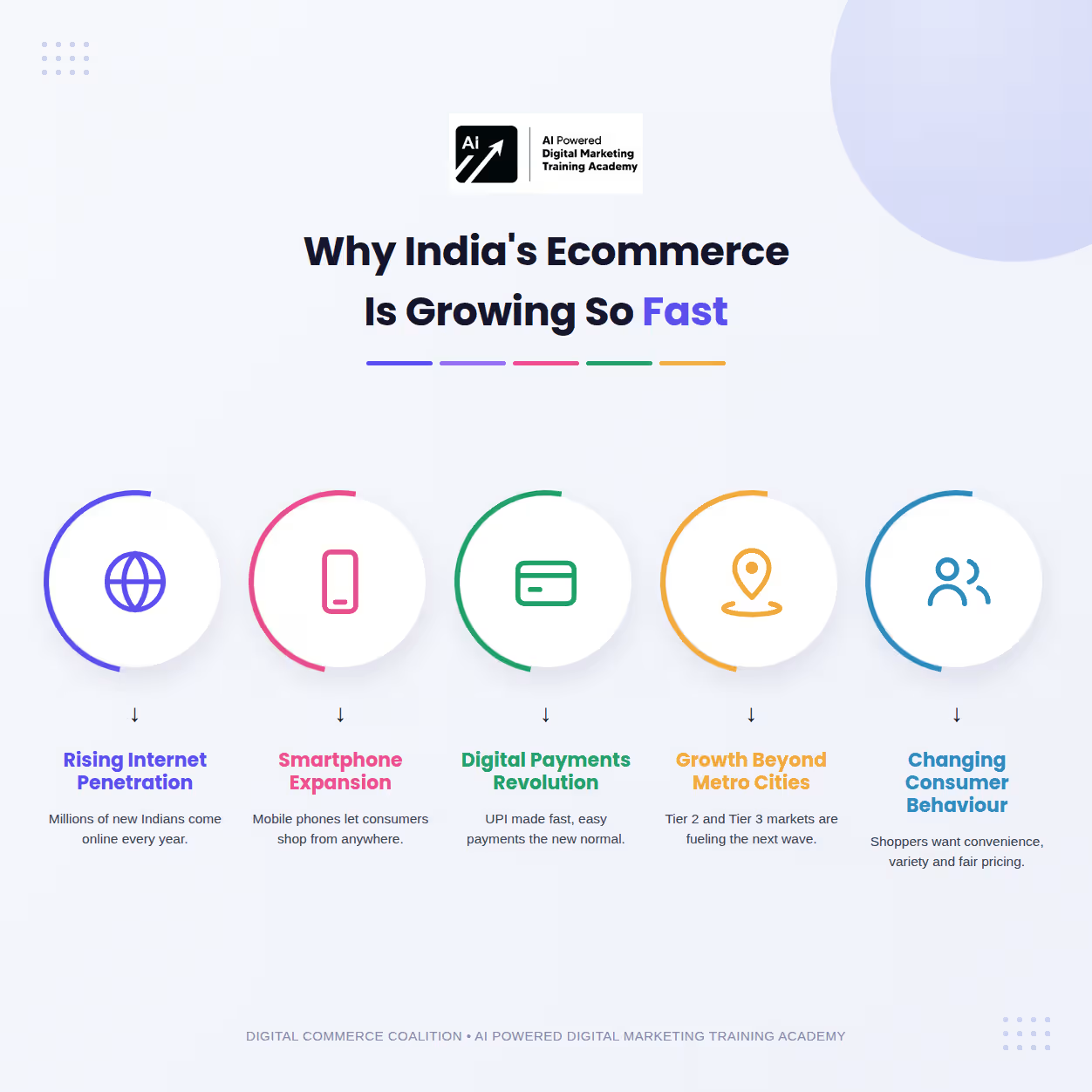
The digital market is one of the growing markets in the world and India is an emerging economy which contributes a lot.
There are a few reasons that contribute to the growth of ecommerce
Rising Internet Penetration
Every year, millions of Indians are coming online.
Digital adoption in the country has also been expedited due to better connectivity over the time
Smartphone Expansion
mobile phones have now enabled millions of consumers to shop online.
Consumers can shop for products and buy them from their mobile devices
Digital Payments Revolution
Online transactions have been transformed by UPI and digital payment platforms.
This helps consumers to make speedy and quick payments from any end
Growth Beyond Metro Cities
E-commerce is fast growing into Tier 2 and 3 cities.
These markets are one of the main driving forces in ecommerce growth
Changing Consumer Behaviour
Modern retail consumers are looking for convenience, a variety of products and competitive pricing.
This shift only further accelerates the adoption of ecommerce
Why Does the Digital Commerce Coalition (DCC) Matter?
The (DCC) is important because ecommerce has moved well beyond being a tiny piece of the economy
It directly impacts:
- Consumers
- Sellers
- Small businesses
- Startups
- Delivery partners
- Technology companies
- Investors
- Employment generation
Millions of livelihoods rely on the ecommerce ecosystem, which serves millions of consumers every day.
In this increasingly organized era, where industries grow larger and more powerful than the State itself, organized representation becomes imperative.
The constitution of (DCC) indicates the ecommerce sector in India is maturing
What Are the Main Priorities of the Digital Commerce Coalition (DCC)?
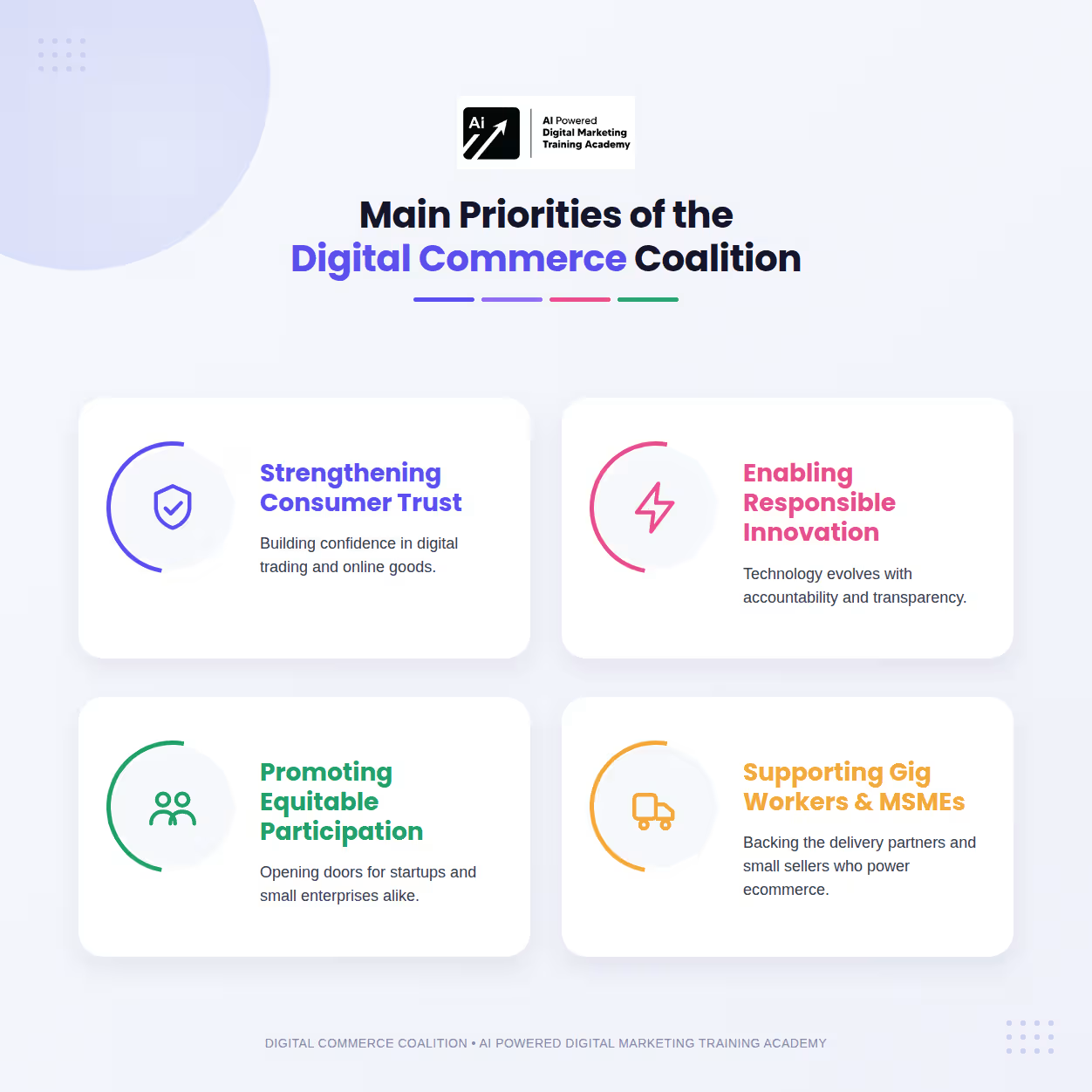
The coalition has identified four major priorities
Strengthening Consumer Trust
Ecommerce is all about trust.
Consumers need to trust digital trading and online goods and services
Enabling Responsible Innovation
Technology continues evolving rapidly.
With accountability and transparency should come innovation
Promoting Equitable Economic Participation
Digital commerce should provide opportunities for start-ups to enterprise.
Inclusive growth remains essential
Supporting Gig Workers and MSMEs
Delivery partners drive a significant part of India’s digital economy driven through delivery platforms partnered, particularly by small businesses.
By supporting their development, it will feed into the growth of the industry over time.
Why Is the Digital Commerce Coalition (DCC) Important for Sellers and MSMEs?
There are millions of Micro Small and Medium Enterprises (MSMEs) in India.
A lot of such stores have grown through ecommerce platforms.
Digital commerce allows sellers to:
- Reach customers across India
- Build online brands
- Sell products beyond local markets
- Reduce dependency on physical stores
- Increase revenue opportunities
The (DCC) is committed to promoting an inclusive digital ecosystem in which businesses of all sizes can compete and thrive
How Does the Digital Commerce Coalition (DCC) Impact Gig Workers?
Gig workers, which enjoy independent working status outside the regular workforce, are key to India’s digital commerce ecosystem
This includes:
- Delivery partners
- Logistics workers
- Warehouse associates
- Last-mile delivery executives
E-commerce has opened fields of employment to millions of people.
With the growth of the sector, conversations on gig worker welfare and social security are beginning to gain prominence.
A core focus area for the (DCC) is assisting gig workers and creating a robust digital ecosystem.
What Does the Digital Commerce Coalition (DCC) Mean for Digital Marketing?
Another shocking development (equally consequential for digital marketers) is the founding of the (DCC).
Digital marketing is the first step in any ecommerce order.
What Customers Usually Do Before Buying Products:
- Search on Google
- Watch videos on YouTube
- Read reviews
- Visit websites
- See social media advertisements
- Compare products online
The entire customer journey is driven by digital marketing.
Over the next few years, as ecommerce continues to grow, expect businesses to increasingly invest in
- Search Engine Optimization (SEO)
- Social Media Marketing
- Performance Marketing
- Content Marketing
- Influencer Marketing
- Email Marketing
- Video Marketing
As a result, the demand for skilled digital marketers will keep on increasing.
How Digital Marketing Helped Build India’s Ecommerce Industry
Technology did not make India’s ecommerce success.
That was mainly because of digital marketing
SEO Increased Product Discovery
Every day, millions of people search online.
Businesses use SEO to get ranked because customers search for products and how businesses provide solutions
Social Media Built Brand Awareness
Thanks to some platforms (namely, Instagram, Facebook and Youtube), ecommerce brands were able to get in front of millions of consumers
Performance Marketing Drove Sales
Then as today, paid advertising allowed businesses to target the right customers and measurehow effective the campaign was.
Influencer Marketing Built Trust
The public is used to receiving recommendations from creators and influencers.
Influencer campaigns have been a vital growth channel to ecommerce brands.
Digital marketing is the #1 biggest growth engine behind ecommerce revolution in India
What Does the Future Look Like for the Digital Commerce Coalition (DCC)?
India’s ecommerce market is poised for growth over the coming few years.
You will have millions of new digital economy consumers
Digital payments which are again going to expand more and more.
Technology adoption will increase.
Consumer expectations will continue evolving.
Meanwhile, conversations surrounding trust building, innovation and ecosystem development will evolve to fester prominently.
That why then (DCC) has formed to get ahead of this.
But the biggest question is why competitors came together.
The key question will be whether the coalition can emerge as a substantive voice in facilitating an Indian digital commerce ecosystem for the future
Conclusion
What else is On the cusp of a fascinating new phase in India’s ecommerce journey, the launch of Digital Commerce Coalition (DCC).
Amazon, Swiggy, Meesho, Zepto and Eternal have realised that competition spurs innovation but once an industry reaches scale it becomes equally critical to collaborate.
The role of India’s digital commerce industry is just getting bigger, more powerful, and a lot more impactful to the economy.
This opens the door to new opportunities for businesses.
This may lead to greater consumer confidence and more effective industry coordination.
For digital marketers it is one of the biggest growth opportunities in this coming decade.
Because the journey to every ecommerce transaction starts with digital discovery.
It all starts with the marketing that drives digital discovery.
The establishment of the (DCC) suggests that the digital economy in India is moving into a new phase one where ecommerce,
tech and digital marketing will develop concurrently while defining the future of all things internet-related commerce in India.