
AI skills for 2026 are becoming essential for professionals who want to stay competitive in a rapidly changing workplace. Many people believe they already understand AI skills because they can generate posts, summarize documents or experiment with prompts.
But 2026 will not reward experimentation alone. It will reward leverage. AI will not replace you. But someone who understands how to build systems with AI might outperform you faster than you expect.
The difference is simple: Using AI occasionally creates output. Building AI-driven systems creates Plan.
We will discuss the AI skills you need for 2026 in simple steps that are easy to follow. No hype. No big promises. Just useful learning.
This is for students, people changing jobs, new business owners, small shop owners and working people who want to use AI skills in real life, in India and anywhere else.
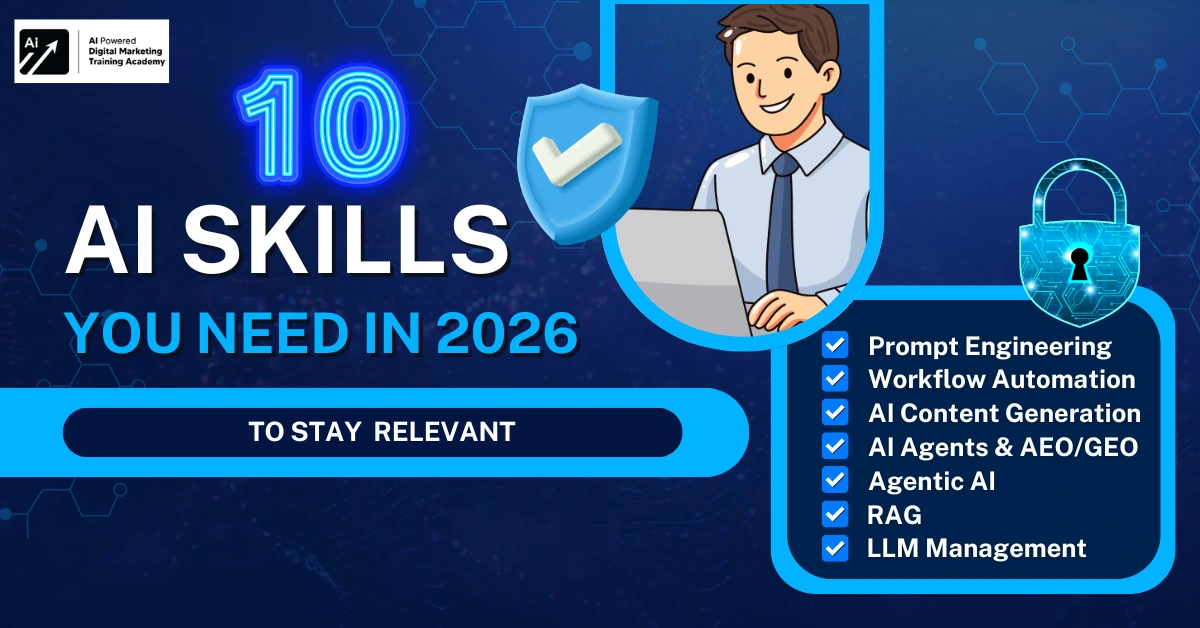
To stay relevant, stop chasing every new AI tool. Instead learn how to use AI in a smart way. Master prompting and workflow automation first. Then move into AI agents and tool stacking. Advanced professionals should learn RAG and LLM management. Track ROI. Build leverage. Keep things simple. Focus on what actually works.
Why 2026 Is a Structural Shift
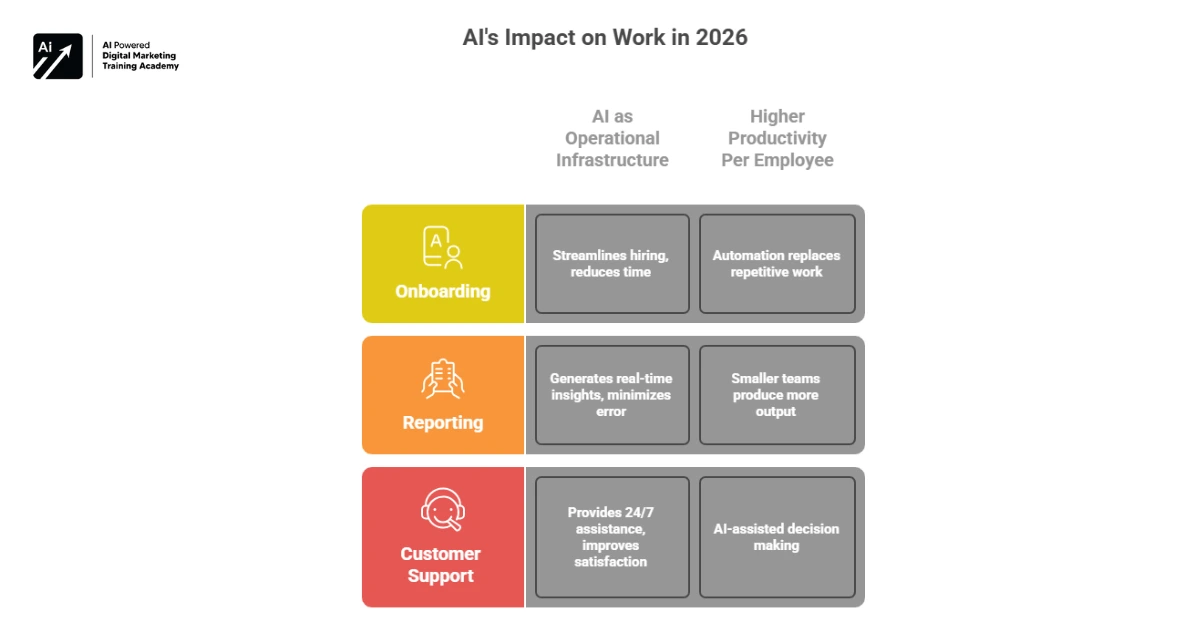
Two transitions are happening simultaneously.




First, AI is becoming operational infrastructure.
Second, organizations expect higher output per person.
In India, startups are increasingly automating onboarding, reporting and customer support instead of expanding teams. Based on observable automation trends across Indian startup ecosystem. Globally, enterprises are optimizing for productivity per employee rather than headcount growth.
The new competitive question is not “Do you know AI?”
Can you use AI to reduce cost, save time or increase output consistently? If you cannot connect AI to measurable impact, you remain replaceable.
The AI Skill Framework for 2026
Instead of chasing every new tool, categorize skills strategically.
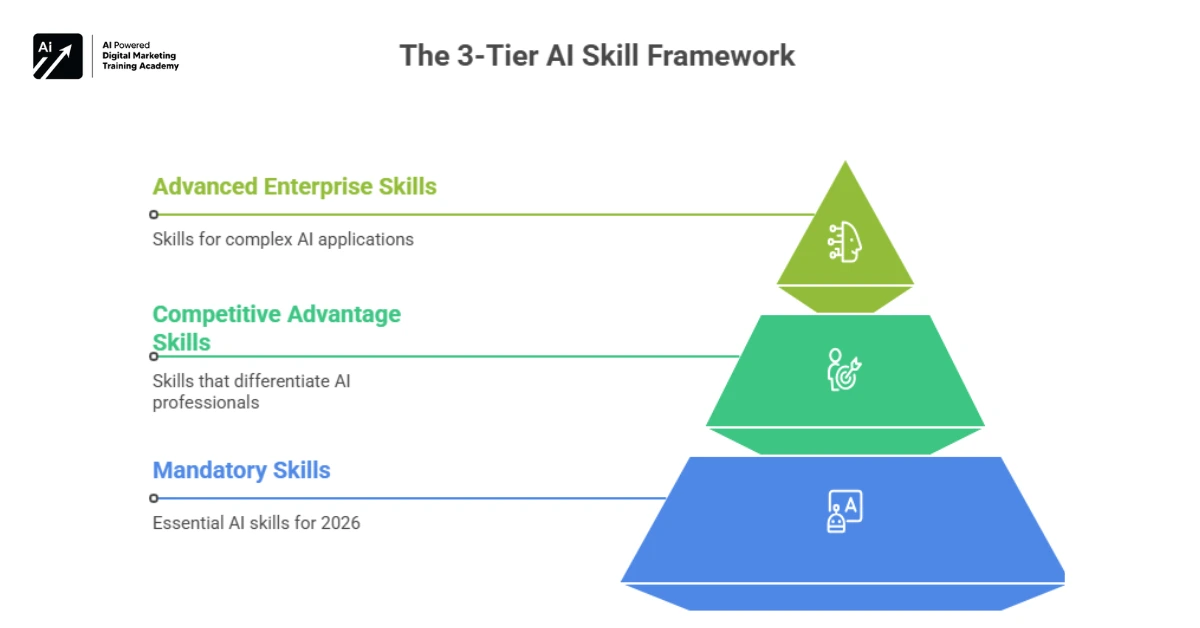
Tier 1 – Mandatory AI Skills
These are foundational:
- Prompt Engineering
- Workflow Automation
- Multimodal AI
- AI Content Generation Systems
Without these, you are merely experimenting.
Tier 2 – Competitive Advantage AI Skills
These create leverage:
- AI Agents
- AI Tool Stacking
- AEO / GEO (AI-era Visibility)
These separate operators from users.
Tier 3 – Advanced / Enterprise Skills
These matter when AI becomes core infrastructure:
- Agentic AI
- RAG Retrieval-Augmented Generation
- LLM Management
Do not jump to Tier 3 prematurely. Master progression.
# 1 Mandatory Skills
1. Prompt Engineering – The Thinking Interface
Prompt engineering is structured communication.
If you ask vague questions, you get generic answers. If you provide role, context, constraints, and output format, AI behaves like a strategist.
Weak prompt:
“Create a marketing plan.”
Structured prompt:
“Act as a SaaS CMO. Create a 90 day go to market plan for an Indian D2C skincare startup with ₹5 lakh budget. Include channels, KPIs, risk analysis and timeline.”
Notice the shift from content to execution.
When to Use Prompt Engineering – AI skills for professionals
- Strategic planning
- Research breakdowns
- SOP creation
- Business modeling
- Risk analysis
Tip #1
Use role-based framing in ChatGPT, Gemini, or Claude before asking for output. It increases structure and relevance.
Prompting is leverage.
But it is not defensible alone. It is the entry point.
2. Workflow Automation – Turning Repetition into Systems
If you do the same task every week, you should not be doing it every time. It should happen on its own.
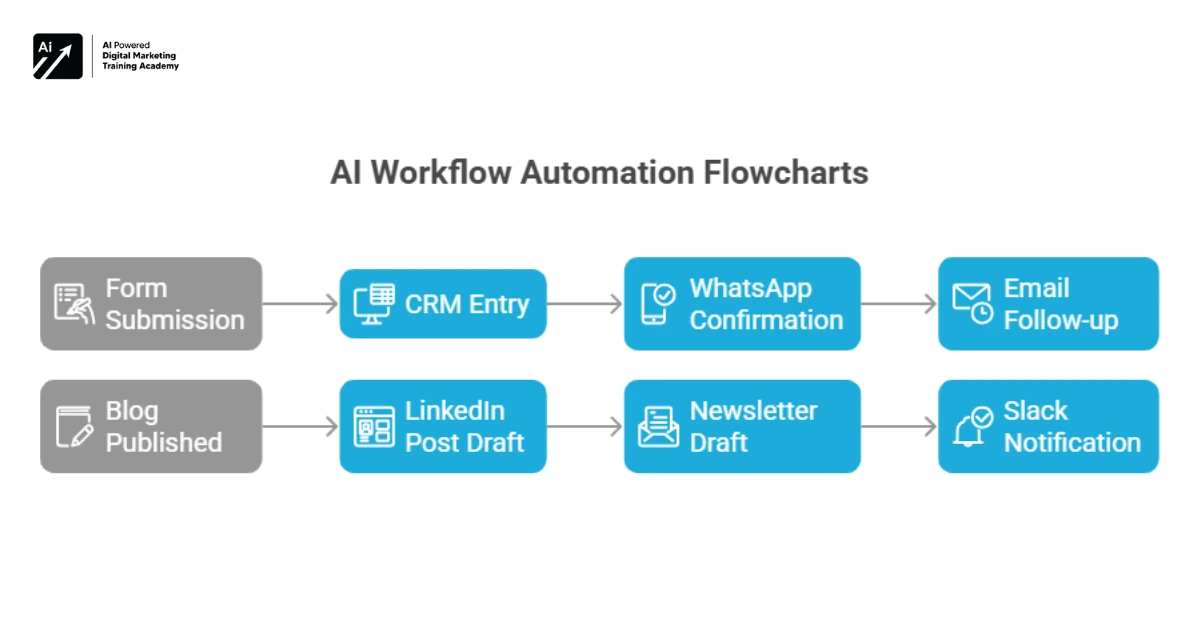
Workflow automation links tools together. So, processes run without manual intervention.
1st Scenario:
Someone fills a form → CRM entry → WhatsApp confirmation → Email follow-up sequence.
2nd Scenario:
Blog published → LinkedIn post draft → Newsletter draft → Slack notification.
Example:
A small edtech company automates student onboarding emails and payment confirmations instead of hiring another admin resource.
20 – 40% reduction in repetitive administrative workload for small teams
Tip #2
Start small. Use just one automation tool at first, like Zapier or Make and get comfortable with it first Map one repetitive workflow. Do not automate chaos.
Automation without process clarity creates bigger problems.
3. Multimodal AI – Beyond Text
AI is no longer limited to text.
Multimodal systems combine:
- Text
- Images
- Audio
- Video
- Code
Imagine writing one long-form article and instantly generating:
- LinkedIn posts
- Instagram carousel copy
- Short-form video script
- AI-generated voiceover
Or uploading a product image and receiving:
- Ad copy
- Landing page draft
- Campaign concept
Tip #3
When creating content, always ask: “Can this be repurposed into 3 additional formats automatically?”
If you are using AI only for text responses, you are underutilizing it.
4. AI Content Generation Systems – Scale Without Burnout
Random AI posts are noise.
Systems create consistency.
1st Scenario:
Problem: Inconsistent publishing
Action: Weekly AI content batching workflow
Result: Stable content pipeline
2nd Scenario:
Problem: Long YouTube videos underused
Action: AI repurposing workflow into short-form clips
Result: 3X content distribution
Small teams cannot afford 10 marketers. AI systems enable consistency without burnout.
Remember: Making content is not the hardest part. You have to show them to right people.
# 2 Competitive Advantage Skills
5. AI Agents – Completion Over Conversation
Chatbots answer.
Agents execute.
An AI agent can:
- Perform weekly competitor analysis
- Qualify inbound leads
- Draft proposals automatically
- Schedule meetings
If you still manually coordinate outputs, you are not using agents fully.
Example:
Startup founder builds an AI agent to filter and categorize 200 weekly inbound emails. Manual sorting eliminated.
This is delegation without payroll.
6. AI Tool Stacking – Building Infrastructure
One tool improves efficiency.
Connected tools create systems.
Freelancer Stack Example:
Notion AI + Zapier + ChatGPT + Canva AI.
Startup Stack Example:
CRM to save customer details + Automation tool to automate work + AI chatbot to answer questions + Analytics dashboard to track results.
Tool stacking is about integration, not accumulation.
If tools do not communicate, you are wasting capacity.
7. AEO / GEO – Visibility in the AI Search Era
Search behavior is shifting.
Users now ask AI:
“Best AI marketing certification in India?”
“Top automation agency for startups?”
If AI engines generate answers and your brand is not referenced, you disappear.
AEO – Answer Engine Optimization and GEO – Generative Engine Optimization focus on visibility in AI-generated responses.
Practical Actions:
- Create structured FAQ sections
- Publish authoritative long-form guides
- Clarify niche positioning
SEO is evolving. Not dying.
# 3 Advanced / Enterprise Skills
8. Agentic AI – Adaptive Systems
Agentic AI goes beyond task execution.
It can:
- Plan multi-step processes
- Adapt to new inputs
- Self-correct mid-task
Use Cases:
- Research automation
- Operations workflows
- QA systems
This is advanced capability. Do not start here unless Tier 1 and 2 are mastered.
9. RAG: Retrieval-Augmented Generation
Generic AI generates responses from general knowledge.
It integrates your internal data so responses are grounded.
Example 1:
HR chatbot referencing company policies.
Example 2:
SaaS support bot pulling product documentation.
RAG improves contextual accuracy but does not eliminate hallucination entirely.
10. LLM Management – Controlling Cost and Performance
When AI becomes operational infrastructure, you must monitor:
- Cost
- Accuracy
- Latency
- Performance
Two major risks:
- Tool sprawl
- Hidden API costs
Without monitoring ROI becomes unclear.
Tools like Arize AI, TruLens, Helicone, and Weights & Biases support observability.
This is not beginner-level. But it becomes critical at scale.
90 Day AI Skill Roadmap
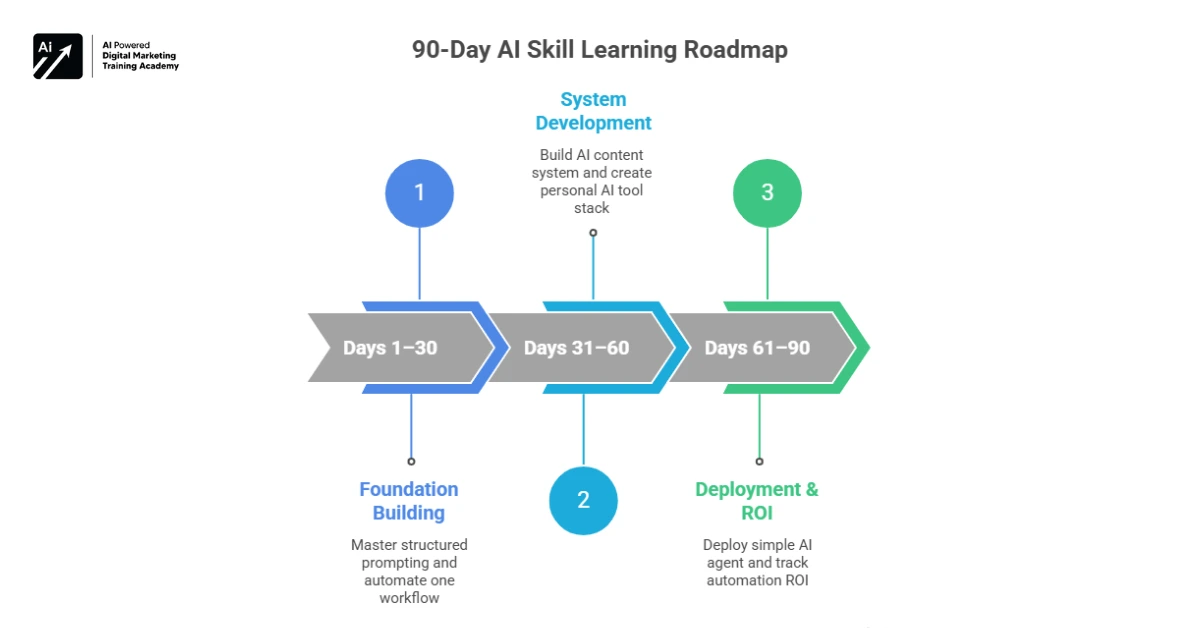
1 – 30:
- Master structured prompting
- Automate one repetitive workflow
31 – 60:
- Build AI content system
- Create personal AI stack
61 – 90:
- Deploy simple AI agent
- Track automation ROI
Measurable KPIs:
- Reduce repetitive manual work by 30%.
- Run one automation workflow continuously for 30 days.
Progress beats complexity.
5 Additional Case Scenarios
Student
Problem: Weak portfolio
Action: Built automation demo
Result: Stronger internship positioning
Freelancer
Problem: Proposal overload
Action: Automated proposal drafts
Result: Time savings and faster response
Startup Founder
Problem: Missed leads
Action: AI lead qualification agent
Result: Faster response time
D2C Brand (India)
Problem: Irregular publishing
Action: AI batch creation workflow
Result: Consistent posting
SaaS Company
Problem: Support overload
Action: RAG-based chatbot
Result: Reduced repetitive ticket volume
Tasks should Automate
- Lead follow-up
- Weekly reporting
- Content repurposing
- Meeting summaries
Tasks should NOT Automate
- Hiring decisions
- Core strategic direction
- Legal approvals
- Final brand positioning
Automation amplifies judgment. It does not replace it.
AI Agent Ideas for Scaling Content
Build a research agent that monitors AI industry updates weekly and drafts insight summaries.
and also content repurposing agent that converts every published blog into 5 distribution assets automatically.
Common Mistakes to Avoid
- Learning tools without workflow clarity
- Jumping to advanced systems too early
- Confusing content volume with business growth
- Over-automating thinking
- Ignoring cost tracking
FAQs: AI Skills You Need in 2026 to Stay Relevant
What AI skills matter the most in 2026?
It’s Prompt Engineering, workflow Automation and AI agents are the main skills, that all the professionals need to adapt to AI-based work.
Is prompt engineering still relevant in 2026?
Yes. It is a foundational skill. However, it must be combined with automation and the system design to create long-term value.
What is RAG in simple terms?
RAG connects AI to your internal data so answers are grounded instead of generic.
Are AI agents replacing jobs?
They replace repetitive tasks, not the high-level strategic thinking.
How do i start learning AI from scratch?
Begin with structured prompting and automate one repetitive task within 30 days.
Conclusion – Build Leverage Not Complexity
You do not need all ten skills immediately.
But ignoring this stack will create long-term disadvantage.
- Start with prompting.
- Move to automation.
- Build systems.
- Track ROI.
In 2026, professionals who leverage AI as a core work system, not as entertainment will remain competitive.