

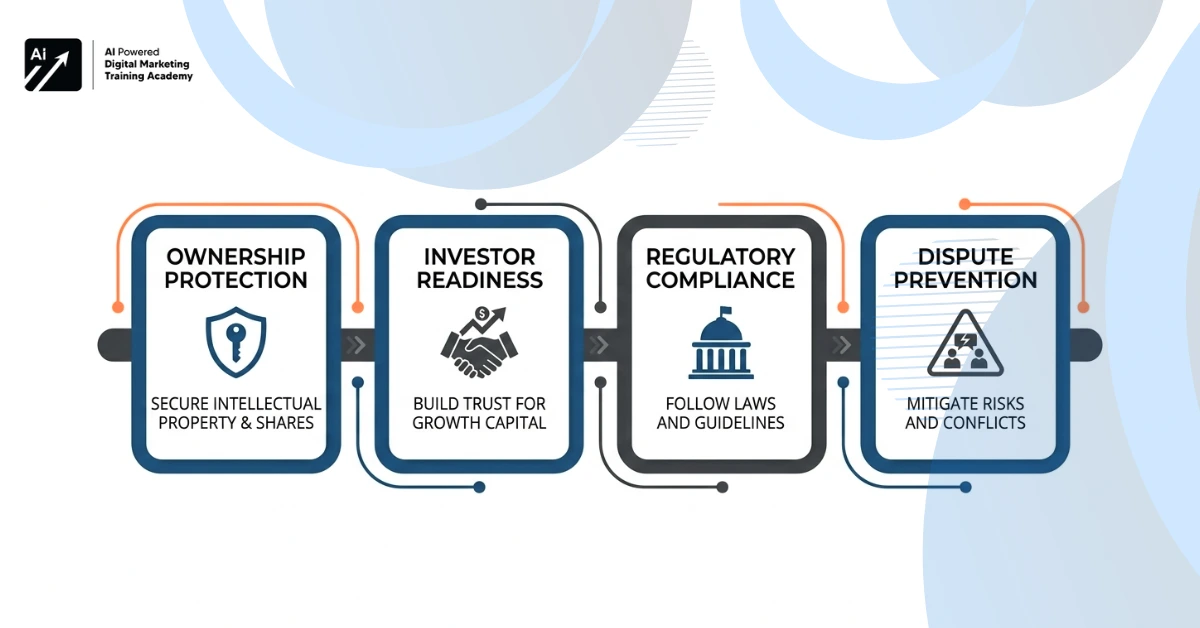
Most of the Indian startups fail because of poor strategy, weak execution, or lack of funding. However, significant number face serious disruption due to legal negligence. Founders often delay documentation, assuming it can be fixed later. Startup legal documents in India are no longer optional administrative tasks. They determine clarity of ownership, control on intellectual property, compliant with legal laws and investor readiness.
In reality, legal gaps become expensive once investors, disputes, or compliance notices enter the picture.
This guide will help early-stage founders, co-founders building new ventures and small business owners formalizing operations. It explains what these documents are, why they matter in the Indian context, and the ten essential legal documents every startup must put in place before scaling.
If legal structure is weak, growth becomes fragile.
WHAT ARE THE STARTUP LEGAL DOCUMENTS IN INDIA?
The Startup legal documents in India are formal agreements and compliance records that refers to how a company is owned, governed and protected under Indian law.
In simple terms, they answer three questions below:
- Who owns the company?
- Who controls decision-making?
- Who owns the intellectual property?
Their basic purpose is risk control, prevent disputes, reduce regulatory exposure, protect company assets, and make the startup eligible for institutional funding. A profitable business can collapse with legal pressure, without these documents.
WHY STARTUP LEGAL DOCUMENTS MATTER IN INDIA?
India’s startup ecosystem has matured now. With over 100,000 DPIIT-recognized startups and increasing venture capital participation, investor due diligence standards have tightened.
Legal hygiene is now a baseline requirement.




From a business perspective, ownership disputes are one of the most common causes of founder fallout. Equity misunderstandings, unclear vesting structures, and undefined exit rights create internal instability. A legally structured startup reduces that risk significantly.
Regulators are starting to look much more closely at things. MCA filings, GST compliance, labor registrations and data protection obligations are increasingly monitored. Non-compliance not just create penalties; but also blocks funding rounds and strategic partnerships.
Finally, clarity on legal, directly impacts valuation. At the time of acquisition or fundraising, investors assess intellectual property ownership, shareholder rights and contractual enforceability. Weak documentation lowers negotiating power.
Legal structure is not bureaucracy. It is the strategic infrastructure.
THE 10 ESSENTIAL STARTUP LEGAL DOCUMENTS IN INDIA
1. Founders’ Agreement
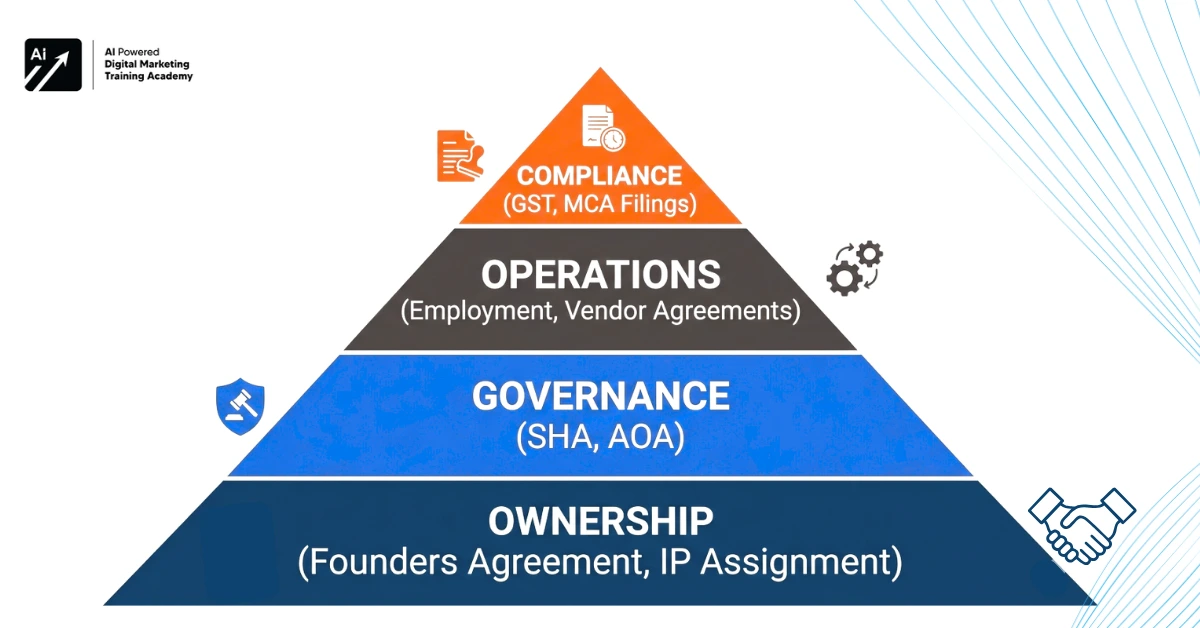
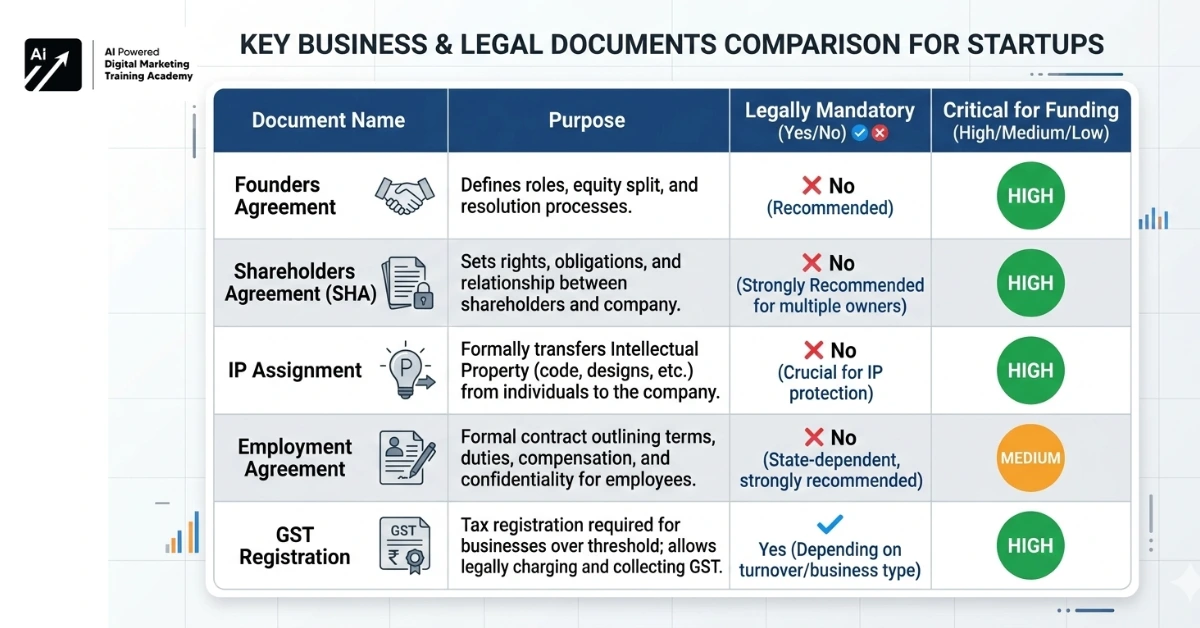
A Founders’ Agreement is the most critical initial-stage document. It defines equity allocation, roles and responsibilities, decision-making authority, vesting schedules and exit clauses.
In India, many founders skip this step due to trust or informal relationships. That is a structural mistake. When equity is not linked to vesting or performance, then disputes become inevitable. This agreement ensures that ownership reflects contribution and long-term commitment.
Without it, co-founder conflict becomes legally messy and financially destructive.
2. Shareholders’ Agreement (SHA)
Once external investors enters into the company, a Shareholders’ Agreement becomes essential. It governs shareholder rights, voting powers, minority protections and exit mechanisms. Such as tag-along and drag-along clauses.
Investors rely heavily on this document for protection. Ineffectively structured SHAs create governance friction and increase litigation risk. A well structured SHA signals maturity and improves investor confidence.
3. Memorandum and Articles of Association (MOA & AOA)
These documents are constitutional, filed during incorporation. The Memorandum defines business objectives, while the Articles govern internal management rules and share structures.
Many startups adopt generic templates. That shortcut creates operational constraints later, especially during fundraising or restructuring. Customized drafting aligned with growth plans is stronger than copy-paste documentation.
4. Employment Agreements
Every employee should have a formal employment contract. This document defines compensation, termination conditions, confidential obligations and intellectual property ownership.
In India, failing to include IP assignment clauses can result in employees retaining ownership of code, designs, or inventions they created. That risk is unacceptable for technology startups.
Employment agreements are protection mechanisms, not HR formalities.
5. Non-Disclosure Agreement (NDA)
This agreement gives assurance, that confidential information shared with employees, vendors, consultants or potential partners is protected. It defines what information is protected, how long confidentiality applies and what remedies exist in case of breach.
Weak NDAs drafted from online templates are often unenforceable. Precision matters here. A properly structured NDA reduces data leakage risk significantly.
6. Intellectual Property Assignment Agreement
This agreement defines the ownership is with company of any software, design, or invention created by the founders, employees or contractors.
Investors demand clear IP ownership. This is critical for technology based startups.
No IP clarity means no funding confidence.
7. ESOP Policy
An Employee Stock Option Plan (ESOP) allows startups to offer equity-based compensation. It defines vesting timelines, exercise pricing and exit rights.
Improper or Verbal equity promises are common in early-stage startups that creates taxation issues and compliance complications. A documented ESOP structure improves employee retention for long-term growth of the organization.
8. Vendor and Service Agreements
In early stages of companies heavily rely on third-party vendors, freelancers and agencies. Structured vendor agreements define scope, payment terms, liability limits that helps in dispute resolution.
Verbal agreements are legally weak and financially risky. A structured vendor agreement protects in managing cash flow and operational continuity.
9. Privacy Policy and Data Protection Compliance
Any organization collecting user data must have a clear privacy policy and must comply with evolving Indian data protection laws. This document explains how data is collected, stored and used or processed.
Non-compliance leads startups to penalties and cause reputational damage. Digital businesses cannot ignore this area.
10. Regulatory Registrations and Compliance Filings
Legal compliance extends beyond contracts. Startups must complete registrations like Certification of Incorporation, PAN & TAN, GST, ROC filing and as MSME if applicable.
Ignoring filing results in penalties and raise red flags during due diligence. Investors treat non-compliance as governance weakness.
BENEFITS OF STRONG LEGAL DOCUMENTATION
Founders with well-structured documentation approach fundraising with greater leverage. Investor trust increases when cap tables are clean and IP ownership is clear.
Operationally, structured contracts reduce internal friction. Clarity in governance improves decision-making speed. Understanding legal structuring gives negotiation capability during investor discussions.
Strong documentation does not guarantee success; however weak documentation reliably creates friction.
CHALLENGES FOUNDERS FACE
Cost sensitivity remains a barrier. Professional drafting requires investment. However, litigation or restructuring costs are significantly higher.
Legal complexity is another barrier. Indian regulatory frameworks evolve, making generic online templates unreliable.
The biggest challenge, however, is postponement. Founders delay legal structuring until a dispute or funding requirement forces urgency. By then, correction becomes expensive.
Ignoring legal groundwork is short-term thinking.
PRACTICAL IMPLEMENTATION APPROACH
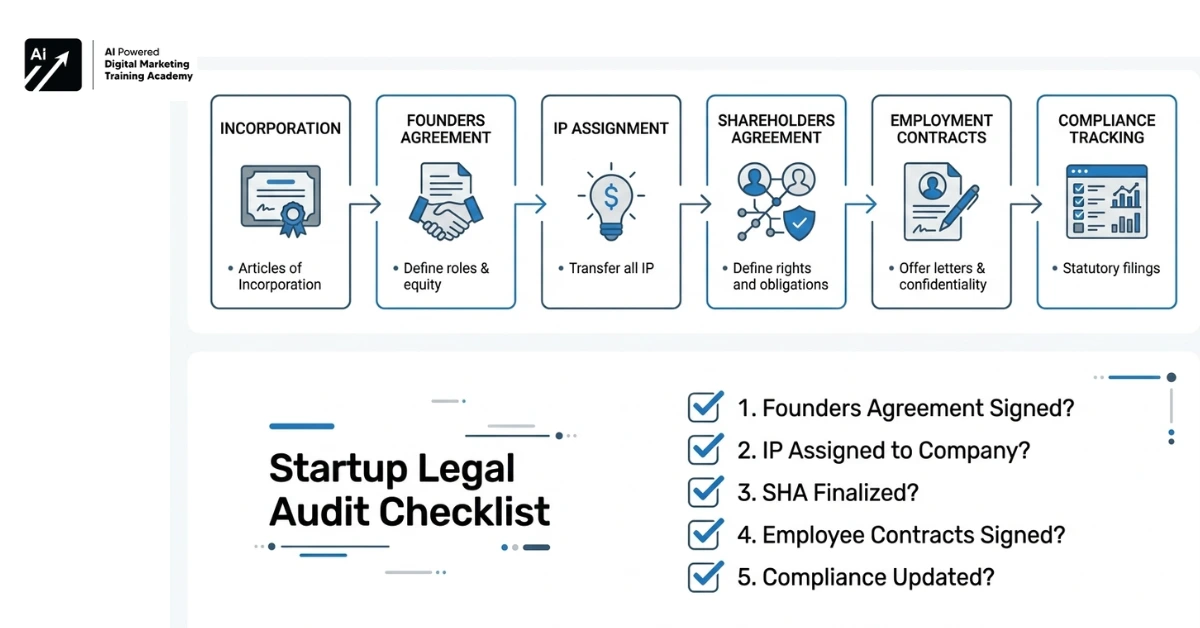
Founders should incorporate properly from the beginning, preferably as a private limited company if scaling is the goal. A Founders’ Agreement must be executed before major equity discussions occur.
All employees and contractors should sign IP assignment and confidentiality agreements from day one. Compliance filings should be tracked quarterly.
A basic internal legal audit within the first 30 days of operations prevents structural weaknesses.
Legal discipline should be proactive, not reactive.
CONCLUSION: STARTUP LEGAL DOCUMENTS
Startup legal documents in India define ownership, protect intellectual property, ensure compliance, and strengthen investor confidence. They are foundational assets, not administrative tasks.
Founders who structure early reduce risk, improve funding readiness, and build scalable businesses with stronger governance.
Legal strength is not optional. It is strategic infrastructure.